


A watch can command attention in global headlines and still tell a different story on a New York resale counter. That distinction sits at the heart of luxury watch market trends nyc in 2026: global demand matters, but local supply, condition, and collector preferences shape what those signals mean here.
It’s understandable to look for a clear read on prices and popular models. A short-term premium, though, is not the same as lasting collector demand, and investment claims rarely capture the full character of a fine watch. In New York’s Diamond District, buyers and dealers encounter a market shaped by international interest and the details of individual pieces.
This article examines forces influencing NYC in 2026, including shifts between new and pre-owned watches, changing collector tastes, and the importance of authentication and condition. It also explains how to distinguish durable patterns from passing market noise, so you can make a more informed decision without treating a watch as a guaranteed investment.
Key Takeaways
- Read a market trend as a sustained pattern, not a single headline or price movement.
- Interpret luxury watch market trends nyc through both global signals and New York’s local dealer and collector activity.
- Compare evidence of lasting collector interest with signs of short-term hype, shifting availability, and resale volatility.
- Before buying, selling, or trading, separate verifiable information from expert interpretation and speculation.
- Assess each watch on its own merits, including authenticity, condition, history, and appeal, rather than assuming market movement guarantees a return.
What Is Shaping the NYC Luxury Watch Market in 2026?
A market trend is a sustained pattern in demand, availability, or buyer behavior, not a single headline or a brief change in an asking price. Understanding luxury watch market trends nyc means reading global signals alongside what is observable in New York. International production and demand influence the watches reaching the city, while local transactions and collector preferences offer a more immediate, but narrower, view.
Collectors track several indicators together because each reveals a different part of the market. Demand reflects buyer interest; supply describes how readily a watch can be sourced; resale activity shows how pieces move after their first sale. Dealer activity can add context about inquiries, offers, and transactions, but no single business sees the entire market. These indicators describe current conditions, not future value or investment returns.
Which signals reveal a real luxury watch market trend?
Look for a pattern that persists across comparable periods, rather than a burst of attention around a release or news story. A high advertised asking price does not prove that a watch sold at that level. Documented completed-sale data is more useful, but assess it alongside the exact reference, condition, completeness, and sale date. Compare like with like and use consistent sources over time.
Collector interest also has more than one dimension. Repeated attention may reflect a model’s design, technical character, provenance, or cultural history, rather than immediate resale demand. The broader history and evolution of the watch helps put contemporary collecting in context, but historical significance alone does not establish current market performance.
Why NYC needs its own market lens
New York is a major collecting and retail hub within a global trade. Its 47th Street Diamond District is a concentrated part of that ecosystem, bringing dealers and buyers into close proximity. Luxury Time NYC is an independent dealer based in the District, where local market knowledge can help put individual watches and transactions in context.
Use local observations alongside broader evidence. If a model attracts attention among New York buyers, compare that signal with completed-sale patterns and availability beyond the city. If global commentary points to rising demand, look for signs of the same movement locally. The strongest reading combines both perspectives rather than treating either as the whole picture.
How Global Demand, Availability, and Resale Activity Reach NYC
New York’s watch market is connected to an international chain. Production and distribution shape how many new watches reach retailers; buyer interest can influence where those watches are sought; and resale listings show what owners are offering. These forces meet in NYC, but a listing or change in global exports does not reveal exactly what is available locally or what New York buyers are paying.
For a broad supply signal, the Federation of the Swiss Watch Industry publishes latest Swiss watch export data. Export figures can help explain changes in shipments and destination markets, but they do not track individual references, local dealer stock, or secondhand transactions. Use them as context for luxury watch market trends nyc, not as a direct measure of the city’s resale market.
How to read price and availability signals responsibly
“A listing price is what a seller is asking; a confirmed sale price is what a buyer actually paid.” Keep that distinction clear when comparing market data. Asking prices show seller expectations, while confirmed transactions offer stronger evidence of what has changed hands. Neither provides a complete picture without context.
Compare the same reference, similar condition and completeness, provenance where relevant, and a comparable sale date. Label asking-price data clearly, identify the dataset or source, and note its limits. A platform’s listings may not reflect every transaction, and advertised pieces may remain unsold or be removed. Check dates and figures before drawing current conclusions rather than relying on an older snapshot.
Why brand-level trends do not explain every watch
Rolex, Patek Philippe, and Audemars Piguet each have distinct histories, designs, and collector communities. Broad interest in a brand can provide useful context, but it does not establish demand for every model or reference. Attention may concentrate on particular designs or periods, while other watches from the same manufacturer follow different patterns.
Individual comparisons matter. Reference, condition, service history, original documentation, and provenance can all influence how two seemingly similar watches are viewed. A global report may point to increased interest across a brand, while NYC transaction evidence may show a more selective response. Keep those observations separate, and avoid turning either into a prediction of appreciation or outperformance.
For a specific watch, professional authentication and careful examination provide essential context alongside market data. Luxury Time NYC offers watch authentication expertise to help assess a timepiece.
Which Luxury Watch Market Shifts Matter Most to NYC Collectors?
The clearest reading of luxury watch market trends nyc comes from separating four forces: enduring collector interest, brief bursts of attention, changes in availability, and resale volatility. They can overlap, but they are not interchangeable. A rising asking price may reflect seller expectations or limited listings; by itself, it does not prove lasting demand, a completed sale, or investment potential.
For each signal, record the date, source, and comparison period. Then look for evidence that can be checked against earlier periods and, where possible, NYC-specific activity. The table offers a practical starting point.
| Market shift | Evidence to seek | Cautious interpretation |
|---|---|---|
| Durable collector interest | Repeated completed-sale activity and sustained buyer attention for comparable watches across multiple periods. | Consistency may suggest lasting interest, but does not guarantee future demand or value. |
| Short-term hype | A sudden rise in coverage, social attention, or asking prices, compared with activity before the spike. | A concentrated burst can fade; attention alone is not evidence of transactions. |
| Availability changes | Dated listings and dealer observations, with the same reference and condition compared over time. | Fewer visible listings may reflect a limited sample, not necessarily a broad supply shortage. |
| Resale volatility | Comparable completed sales across consistent time periods, with condition and completeness accounted for. | Movement may be specific to a reference or sale context, rather than a whole brand or market. |
Lasting collector interest versus short-lived market attention
Repeated activity across separate periods is more informative than a single headline, viral discussion, or scarcity claim. A model that continues to attract considered interest after a news cycle has passed may merit closer study. Treat that as a reason to investigate, not a forecast. Check whether the evidence reflects actual transactions and whether the watches involved are genuinely comparable.
What comparisons between brands can, and cannot, show
Rolex, Patek Philippe, and Audemars Piguet each have distinct collector communities. Comparing them is meaningful only when the evidence uses the same dates and measures, such as completed sales against completed sales, not one brand’s asking prices against another’s transaction data. A brand-wide pattern also cannot explain every reference, condition, or provenance.
NYC’s retail environment provides useful context, though retail investment is not a direct measure of watch resale demand. Cushman & Wakefield’s report on NYC's luxury retail landscape can help frame the wider setting. For collector decisions, pair that perspective with dated watch-market evidence and local transaction observations.
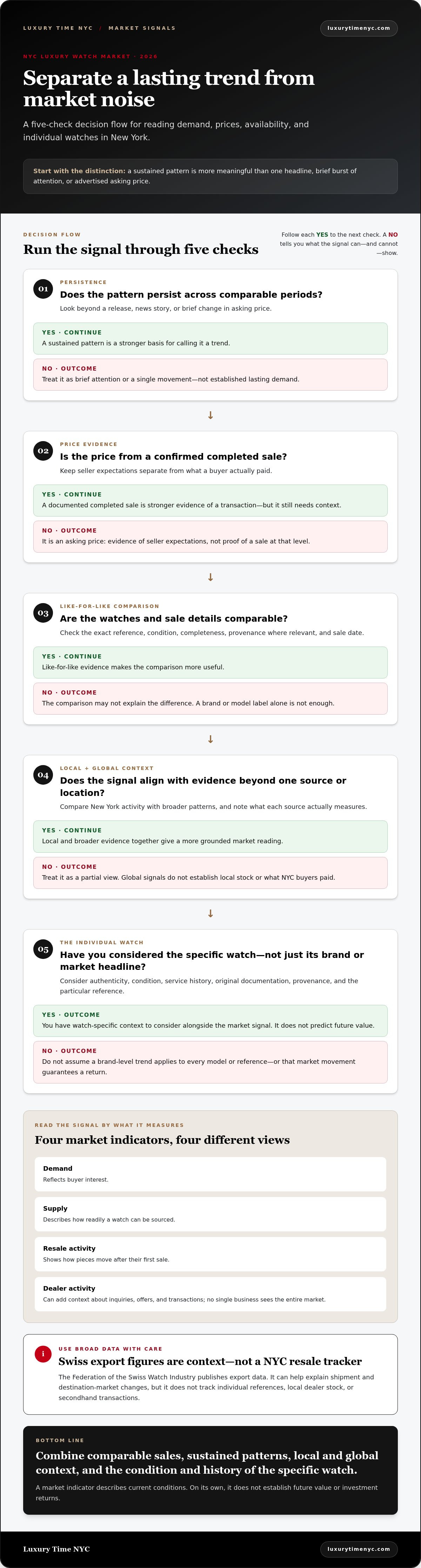
How to Evaluate a Luxury Watch Trend Before Acting
Before a market narrative shapes a purchase, sale, or trade, test its evidence against the watch itself. For collectors tracking luxury watch market trends nyc, a disciplined review separates what can be verified from informed interpretation and speculation. This five-step check helps keep those categories distinct.
- 1. Define the comparison. Identify the exact brand and reference, the watch’s condition and completeness, and the period the claim covers. Broad statements about a brand can obscure meaningful differences between individual watches.
- 2. Trace the original source. Find where the figure came from. Determine whether it reflects advertised listings, reported completed transactions, dealer observations, or another measure. Do not describe asking prices as confirmed sales.
- 3. Check the comparison set. Compare like with like across multiple periods. Note the dataset’s coverage and any gaps, such as a limited number of listings or missing transaction details. A small or uneven sample can make a change appear more decisive than it is.
- 4. Label the conclusion. Present documented figures as evidence, explain expert interpretation as interpretation, and identify predictions as speculation. A pattern in past activity does not establish what will happen next.
- 5. Connect the trend to your decision. Consider whether the evidence relates to your purpose and the particular watch, rather than assuming a market-wide claim settles a purchase, sale, or trade decision.
For a broader framework around transactions, see this guide to luxury watch buying and selling.
Then assess the individual piece. Authenticity, provenance, condition, documentation, and service history can all affect how a watch should be understood and compared. Professional authentication helps establish whether a watch is genuine; it is a safeguard, not a promise of market performance or financial return. A comparison with another example is most meaningful when its reference, condition, and supporting records are also considered.
For a practical example of watch-specific evaluation, read the NYC luxury watch buying guide. Luxury Time NYC provides watch authentication to help collectors assess a timepiece with greater clarity. Explore watch authentication as part of a careful review before making a decision.
What NYC’s 2026 Watch Market Means for Collectors
No single direction describes every corner of New York’s watch market. Global production and buyer interest shape the wider environment, while NYC availability, completed transactions, and collector priorities offer a more local reading. In 2026, the prudent approach is to look for patterns across time, references, and sources, while treating short-lived attention and asking-price changes with care.
Market trends inform decisions, but they cannot guarantee outcomes. If you monitor a collection, keep dated records of condition, service history, provenance, and comparable sales. Those details make it easier to understand a watch’s place in the market without assuming that a broad brand trend applies to every piece.
A measured outlook for NYC collectors
Authentication, condition, and careful comparison matter in any market climate. What is less certain is whether a recent burst of attention or a change in visible availability will persist. Global reports can help explain forces behind supply and demand, but they do not replace local transaction context. New York dealer observations add perspective, not a complete account of the city’s activity.
If you’re considering a purchase, focus first on the specific watch: its reference, condition, authenticity, and appeal to you as a collector. If you’re weighing a sale or trade, compare relevant completed transactions and account for the individual timepiece rather than relying on a headline or broad market claim. Neither decision should rest on an assumption of future returns.
Where to continue your research in New York
The 47th Street Diamond District is a useful place to understand New York’s watch trade and its local retail context. Luxury Time NYC is based in the Diamond District and offers an appointment-based showroom and a curated selection of authenticated watches. Use local dealer insight alongside broader evidence when evaluating a market trend.
For a considered next step, explore the authenticated selection or arrange an appointment to discuss a timepiece with the team. Start with the watch itself and the evidence you can examine clearly.
Make Your Next Watch Decision With Clarity
The luxury watch market trends nyc collectors encounter in 2026 are best read through more than headlines or asking prices. Compare dated evidence, distinguish listings from completed sales, and assess each watch on its own merits, including authenticity, condition, and provenance. A broad market pattern can offer context, but it cannot predict a particular watch’s future value.
Luxury Time NYC is an independent luxury-watch dealer founded in 2005 in New York’s historic Diamond District. The team offers authentication, sourcing, buying, selling, trading, and repair services. Its experience can help put a timepiece in context alongside evidence from the wider market.
Explore Luxury Time NYC’s authenticated watch selection or discuss a timepiece with the team. Take your time, ask careful questions, and let knowledge guide your next step. A considered choice can be rewarding for the craft, history, and personal meaning it brings to your collection.
Frequently Asked Questions
What are the current luxury watch market trends in NYC?
NYC’s market is shaped by selective collector interest, changing availability, and resale activity that can differ by watch and reference. Some rare or historically significant pieces may attract sustained attention, while other watches can see changing resale premiums. To understand luxury watch market trends nyc, compare dated completed sales with current listings and local dealer observations rather than treating one headline as the whole market.
Are luxury watches increasing in value in 2026?
No single answer applies to every luxury watch in 2026. Resale conditions vary by brand, reference, condition, completeness, and provenance; some pieces may hold interest while others see softer premiums or fluctuating asking prices. A listing price does not prove a sale or establish lasting demand. Review comparable completed transactions across consistent periods, and avoid assuming that past price movement predicts future value.
How can I tell whether a watch market trend is real?
Look for repeated, comparable evidence across multiple periods. Identify the exact reference and condition, then trace the source and determine whether it reports asking prices or completed sales. Check how broad the data is and note gaps in its coverage. A burst of publicity or a few high listings may signal attention, but sustained transaction activity offers stronger evidence. Keep observations separate from predictions.
Does the NYC luxury watch market follow global trends?
NYC is connected to global production, distribution, and buyer demand, so international shifts can influence local availability and interest. The city’s market may respond differently because local inventory and collector activity are only part of the wider picture. Use global reports as context, then compare them with dated New York transactions and dealer observations. Neither view alone describes the entire market.
Which luxury watch brands are most in demand in New York?
There is no reliable universal ranking that identifies one brand as most in demand across New York. Rolex, Patek Philippe, and Audemars Piguet each have distinct collector communities, and interest can vary by reference, condition, and period. A brand-wide signal does not establish demand for every watch it makes. Compare like-for-like transaction evidence before drawing conclusions about a particular timepiece.
Do luxury watches make a good investment?
A luxury watch should not be treated as a guaranteed investment. Resale outcomes can vary, and an asking price or past increase does not promise a future return. Consider a watch first for its craftsmanship, history, and personal appeal, then examine authenticity, condition, provenance, and comparable completed sales. If you’re making a purchase, sale, or trade decision, base it on the individual piece and your collecting goals.
Why is the Diamond District important to NYC watch collectors?
The Diamond District, centered on 47th Street, is a concentrated part of New York’s luxury-watch trade, bringing dealers and collectors into a well-known retail hub. It offers a local perspective on buying, selling, sourcing, and authentication, but its activity does not represent every transaction across the city. Use district observations alongside broader market evidence. Luxury Time NYC has been based in the Diamond District since 2005.


