


The most prestigious route isn’t always the right one. A luxury watch may attract competitive bidding at auction, while a private sale may offer more discretion and control. For collectors weighing both paths, navigating watch auctions vs private sale means looking beyond the headline estimate to the written terms, expected timeline, and likely net proceeds.
Before committing a significant timepiece, consider how authenticity, condition, documentation, commissions, and other charges could affect the transaction. The level of exposure may matter as much as the final price. The right choice depends on whether you’re buying or selling, what you value most, and what the specific arrangement offers.
This guide compares auction and private-sale routes through control, certainty, fees, and timing. You’ll learn which terms and records to examine, how a direct dealer purchase or consignment differs from an auction, and when each approach may suit your objectives. If you’re considering a private transaction, a specialist in New York’s Diamond District can discuss authentication and handling, so you can understand the trade-offs before deciding.
Key Takeaways
- Compare the terms for each route, including exposure, control, timing, fees, privacy, and settlement, before committing.
- When navigating watch auctions vs private sale, match the process to your priorities rather than relying on an estimate or headline result.
- Consider how rarity, condition, provenance, completeness, and current market interest may influence which route suits a particular watch.
- Before bidding, buying, or selling, document the reference, condition, service history, provenance, and included accessories.
- Understand the difference between an auction and a dealer’s direct purchase or consignment, then choose the level of visibility and discretion that suits you.
Watch Auctions vs. Private Sale: What Each Route Actually Means
A luxury watch transaction involves trade-offs: broad visibility or discretion, a defined schedule or greater flexibility, and control over terms or the possibility of competitive bidding. The right route depends on what you’re buying or selling, the watch itself, and the counterparty. Understanding how each process works is the first step in navigating watch auctions vs private sale with clear expectations.
What happens when a watch goes to auction?
An auction is a timed, competitive bidding process governed by published sale terms. As a foundational overview of an Auction explains, bidders compete to purchase an item. For a watch, the auction house typically catalogues the piece, reviews its condition, and publishes an estimate before bidding opens. The estimate is guidance, not a promised result.
Before consigning, ask whether a reserve applies, what happens if bidding falls short, and how settlement and delivery are handled. Schedules, seller obligations, and sale terms vary by auction house. Before consigning or bidding, verify the current buyer’s premium, seller commission, and any other charges in the relevant terms.
What counts as a private watch sale?
“Private sale” can refer to several arrangements. A dealer purchase is an outright sale to a professional buyer. In a dealer’s retail sale, a collector buys a watch offered by the dealer. With consignment, the owner places a watch with a professional intermediary to present to prospective buyers; the watch sells later if a buyer is found on acceptable terms. A direct transaction between individuals is another possibility.
Luxury Time NYC, an independent dealer in New York’s Diamond District, buys, sells, and trades watches and offers consignment. Its consignment service includes professional photography, authentication, and exposure to a global buyer network. This is distinct from an auction: Luxury Time NYC does not operate or broker auctions. If you’re considering consignment, confirm current eligibility, terms, fees, and expected timing directly with the dealer.
Neither route guarantees a particular outcome. A rare reference with strong provenance may attract a different audience than a more common model. Condition, completeness, market interest, sale terms, and the counterparty also affect the transaction. Compare the specific arrangements, not just each format’s reputation.
How Auction and Private-Sale Processes Affect Control and Certainty
The distinction is not simply public versus private. Each route assigns control, exposure, and responsibility differently. A comparison of auction and private sale from Christie’s also highlights how visibility, competition, discretion, and timing can shape the decision. Assess the terms of the specific transaction rather than making assumptions about the format.
| Factor | Auction | Private sale |
|---|---|---|
| Exposure | Catalogue and sale promotion may reach a broad pool of bidders. | Can be handled more discreetly, depending on the buyer or intermediary. |
| Control | Sale terms, schedule, and bidding rules shape the process. | Terms may be discussed directly, but depend on the counterparty and arrangement. |
| Timing | Follows the auction house’s calendar and settlement process. | Varies; an offer may be direct, while consignment requires a later buyer. |
| Fees | Buyer’s premiums, seller commissions, and other charges may apply. | Dealer purchase and consignment have different terms; confirm all charges in advance. |
| Privacy | Public bidding and published results may make the transaction more visible. | Potentially more private, subject to the process and parties involved. |
| Settlement | Governed by the auction house’s payment deadlines and sale conditions. | Set by the agreed transaction terms; confirm payment and delivery arrangements. |
Auction trade-offs for buyers and sellers
For sellers, catalogue exposure may attract competing bidders, but an estimate is not a promise of the final result. Bidding, any reserve, and the auction’s terms all matter. Buyers should review the condition report, lot description, sale conditions, payment deadline, and stated buyer protections before bidding. Check the auction house’s current fee schedule and seller obligations directly, since charges and procedures can differ.
Private-sale trade-offs for buyers and sellers
An outright dealer offer gives the seller a defined proposal to consider. Consignment is different: the watch is presented to find a later buyer, so clarify commission, expenses, timing, and payout terms before agreeing. Buyers should examine authentication, condition disclosure, return terms, and payment security. Discretion and speed aren’t automatic; both depend on the arrangement and counterparty.
Neither route guarantees a particular price, buyer, or completion date. When navigating watch auctions vs private sale, compare the written terms and responsibilities before weighing the potential advantages. Collectors considering a direct purchase or consignment can review Luxury Time NYC’s watch buying and selling options as one private-sale alternative to auction.
Which Route Fits Your Watch, Priorities, and Transaction?
Choose a route based on your objective, not its reputation. A seller who prioritizes a direct offer may prefer to explore a dealer purchase; one willing to wait for a buyer may consider consignment or auction. A collector seeking a particular reference may value the breadth of a scheduled auction, while a private dealer may be able to assist with sourcing. Neither route guarantees a match, a sale, or a preferred completion date.
The watch matters, too. Rarity, condition, provenance, completeness, and current market interest can affect its appeal to bidders or private buyers. A documented, unusual timepiece may draw interest in a competitive sale, but bidding remains uncertain. A more widely traded model may suit a direct offer or consignment, depending on demand and terms. Treat these as possibilities, not rules.
| Route | Potential advantages | Points to weigh |
|---|---|---|
| Auction | Scheduled sale and catalogue visibility may reach interested bidders. | Final result depends on bidding; review estimates, reserve terms, fees, and sale conditions. |
| Private sale | May allow greater discretion and a direct conversation about terms. | Buyer access, timing, and outcome depend on the arrangement and counterparty. |
When an auction may suit your goals
A seller comfortable with public exposure and an uncertain result may value the structure of a scheduled auction, particularly if competitive bidding is a priority. Buyers may appreciate a curated catalogue and a defined sale date, though a desired reference may attract competing bids or fail to appear. Before proceeding, scrutinize the estimate, reserve, buyer’s premium, seller charges, condition information, and sale conditions.
When a private sale may suit your goals
If discretion or a direct proposal matters most, ask a reputable dealer whether an outright purchase is appropriate. Consignment offers another path: the watch is presented to prospective buyers, and payment depends on a later sale. A professional intermediary may assist with authentication, sourcing, and transaction coordination. Luxury Time NYC offers buying, selling, trading, consignment, and watch authentication from its New York Diamond District business. Confirm the specific terms and timing before proceeding.
For a fuller framework on choosing a buyer or seller and reviewing a watch, consult this Due diligence guide. The companion article, “The Best Place to Sell Watches in 2026,” can also help you consider how to evaluate your selling options. Ultimately, navigating watch auctions vs private sale means weighing your priorities against the watch’s individual merits, then verifying the proposed terms in writing.
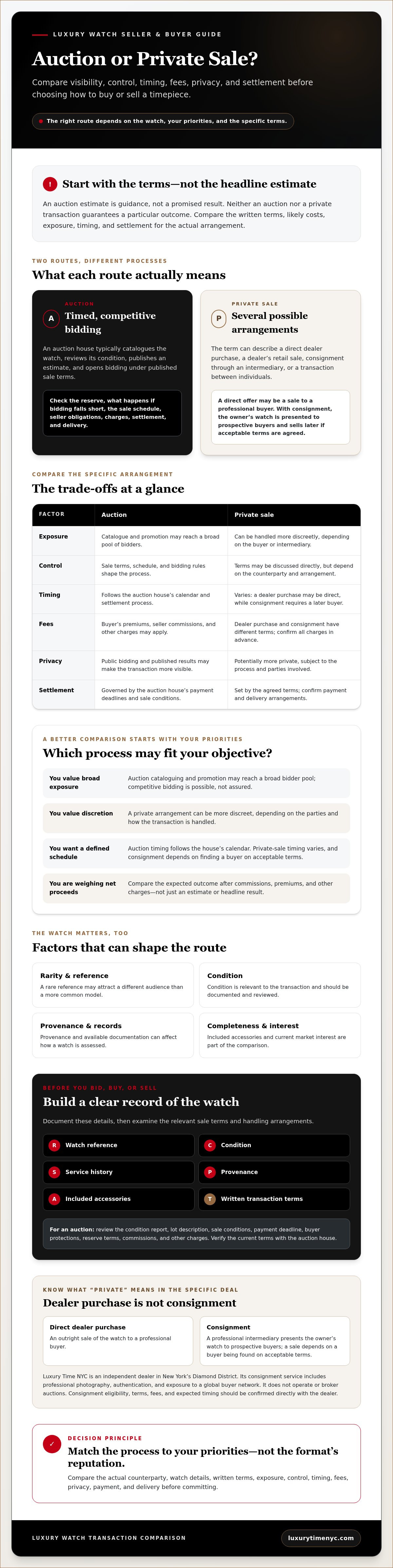
Due Diligence Before You Bid, Buy, or Sell a Luxury Watch
Good documentation helps you describe the watch accurately and understand the transaction. Before choosing a route, gather the records you have and clarify what the other party will verify. Use this checklist to make navigating watch auctions vs private sale a more informed decision.
- Identify the watch. Record the brand, reference, serial details where appropriate, and distinguishing features. Compare them with the available paperwork.
- Document condition. Note visible wear, replaced or damaged components, and known mechanical concerns. Ask how condition will be assessed and recorded.
- Gather service records. Collect service invoices, movement work records, and other relevant history. Don’t present undocumented work as confirmed fact.
- Establish provenance. Organize purchase records and ownership documentation you can share. Clarify what is known and what remains unverified.
- List what’s included. Record whether the original box, papers, accessories, and additional links are present.
- Read the written terms. Check fees and expenses, insurance responsibility, shipping arrangements, payment deadlines, and the conditions for withdrawing or cancelling.
- Verify cross-border and tax questions. If the transaction involves another jurisdiction, seek advice from qualified tax, customs, or legal professionals. Don’t rely on informal assurances about obligations.
Questions sellers should ask before consigning or accepting an offer
Ask who authenticates the watch, how its condition is recorded, and what documentation you’ll receive. For an outright offer, confirm whether acceptance completes the sale and when payment is due. For consignment, establish the commission, other expenses, insurance responsibility, sale timing, and payout terms in writing. The article “How to Sell Your Luxury Watch in NYC for the Best Price” can provide a further framework for evaluating the process.
Questions buyers should ask before bidding or purchasing
Request a clear condition description, provenance details, and disclosure of known issues. Ask what the seller’s or auction house’s authenticity policy covers, whether inspection is possible, what return conditions apply, and how payment and delivery are secured. For a Rolex purchase, see “The Essential Guide to Buying a Rolex in NYC: 2026 Collector’s Edition” for additional buyer considerations.
Keep copies of correspondence and the final agreement. A qualified professional can help resolve questions about tax, import, or legal implications that depend on the parties and transaction. For an in-person discussion about watch authentication or a potential sale, you can contact Luxury Time NYC, an independent dealer in New York’s Diamond District. Showroom visits are by appointment.
A Discreet NYC Next Step: Compare Your Options With Luxury Time
An auction offers a structured bidding environment, with the outcome shaped by bidder interest and the sale’s terms. A private sale can provide a more tailored process, whether you’re considering a dealer’s direct offer or consignment. Neither route is right for every watch or objective. Navigating watch auctions vs private sale means comparing the actual terms with your priorities, rather than assuming one format will deliver a particular result.
Luxury Time NYC is an independent luxury-watch dealer in New York’s Diamond District. The business buys, sells, and trades watches, and offers consignment and watch authentication. It does not operate or broker auctions. For collectors considering a private transaction, understanding the difference between its direct retail and consignment services is a useful starting point.
How Luxury Time NYC can support a private transaction
A direct dealer transaction and consignment follow different processes. In a direct purchase, the dealer considers the watch for purchase. Consignment places it with the dealer to present to prospective buyers, with a sale dependent on finding a buyer under agreed terms. Luxury Time NYC’s consignment service includes professional photography, authentication, and exposure to a global buyer network.
Before proceeding, ask about current eligibility, fees, expenses, timing, and responsibilities. Review the terms in writing, including how the watch will be handled and when payment would be made if it sells. These details can vary, so confirm them directly rather than relying on general expectations.
Prepare for a considered conversation
A little preparation makes a discussion more useful. Gather the watch’s reference information, available purchase and service records, provenance details, and any included box, papers, or accessories. Note the condition as you understand it and list questions about authentication or possible transaction routes. Clear records help establish what is known before you discuss terms.
For New York collectors, Luxury Time NYC’s Diamond District showroom is available for visits by appointment. If you’re weighing a private sale, consignment, or another option, contact the team to discuss the watch and clarify which process may fit your circumstances. A conversation can help you compare next steps without committing before you understand the terms.
Choose Your Watch’s Next Chapter With Confidence
The right route depends on your priorities and the watch itself. An auction offers a structured bidding environment, while a private sale may allow a more tailored process. Neither removes the need to review terms carefully. Before deciding, compare timing, control, fees, privacy, and settlement, and organize the records that support the watch’s condition, provenance, and service history.
Navigating watch auctions vs private sale becomes clearer when you focus on what matters most: a direct offer, broad auction exposure, or the possibility of consignment. Luxury Time NYC is an independent luxury-watch dealer founded in 2005, not an auction house. Its consignment service includes professional photography, authentication, and exposure to a global buyer network. Confirm current eligibility, fees, and terms before proceeding.
If you’d like to discuss a private-sale option, Luxury Time NYC welcomes appointment-based visits at its New York Diamond District showroom. Bring the watch’s reference details and any available records or accessories to support a considered conversation. Discuss a private-sale option with Luxury Time NYC and take your next step with clarity.
Frequently Asked Questions
Is it better to sell a luxury watch at auction or privately?
The better route depends on your priorities and the watch. An auction may suit sellers seeking broad exposure and competitive bidding; a private sale may offer more discretion or a direct offer. Consider your desired control, timing, fees, and appetite for uncertainty. Neither route guarantees a specific result. Compare written terms, then weigh whether an outright dealer purchase or consignment better matches your objectives.
Can I sell my watch privately without using an auction house?
Yes. A private sale may be arranged directly with a buyer or through a dealer, according to the parties’ terms. An outright dealer purchase is distinct from consignment, where the dealer presents the watch to prospective buyers and a sale may happen later. Before handing over a valuable timepiece, verify authentication procedures, condition documentation, payment security, insurance responsibility, fees, and settlement terms in writing.
How much does it cost to sell a watch at auction?
Auction charges vary by house, sale, and seller agreement, so there’s no single fee that applies to every watch. The seller may be responsible for commission or other charges under the consignment terms. Before consigning, review the current written agreement for seller fees, insurance, shipping, reserve conditions, and payment timing. Ask the auction house to clarify any cost or obligation you don’t understand before proceeding.
What happens if my watch does not sell at auction?
The next steps depend on the auction house’s agreement and published sale conditions. Relisting, collecting the watch, or pursuing another sale route may be possible, but don’t assume any option is automatic. Before consigning, confirm in writing what happens if the lot remains unsold, including reserve terms, any unsold-lot charges, return arrangements, and deadlines for collection or other instructions.
Are private watch sales safer than auctions?
Safety depends on the counterparty and safeguards, not simply on whether a sale is private or public. Buyers and sellers should verify the other party’s policies, document condition, and confirm authentication procedures. Use secure payment and clearly agreed, insured shipping arrangements where applicable. Review the written terms before transferring funds or the watch. Privacy can limit exposure, but it doesn’t by itself ensure a secure transaction.
What should I check before buying a watch at auction?
Review the catalogue description, condition details, provenance, and included accessories, then examine buyer charges, payment deadlines, inspection options, and return terms. Photographs and estimates aren’t substitutes for careful review of the written lot information. Confirm the auction house’s authentication procedures and read the sale conditions for any limits on its responsibilities or buyer protections. Ask questions before bidding if a detail remains unclear.
Can a watch dealer sell my watch on consignment?
Yes. Some dealers offer consignment, presenting a watch to potential buyers and paying the seller according to agreed terms after a sale. Luxury Time NYC’s consignment includes professional photography, authentication, and exposure to a global buyer network. Confirm current eligibility, fees, insurance responsibility, expected timing, and payment terms directly with the dealer. Consignment differs from an outright purchase, where the dealer makes an offer to buy the watch.


