


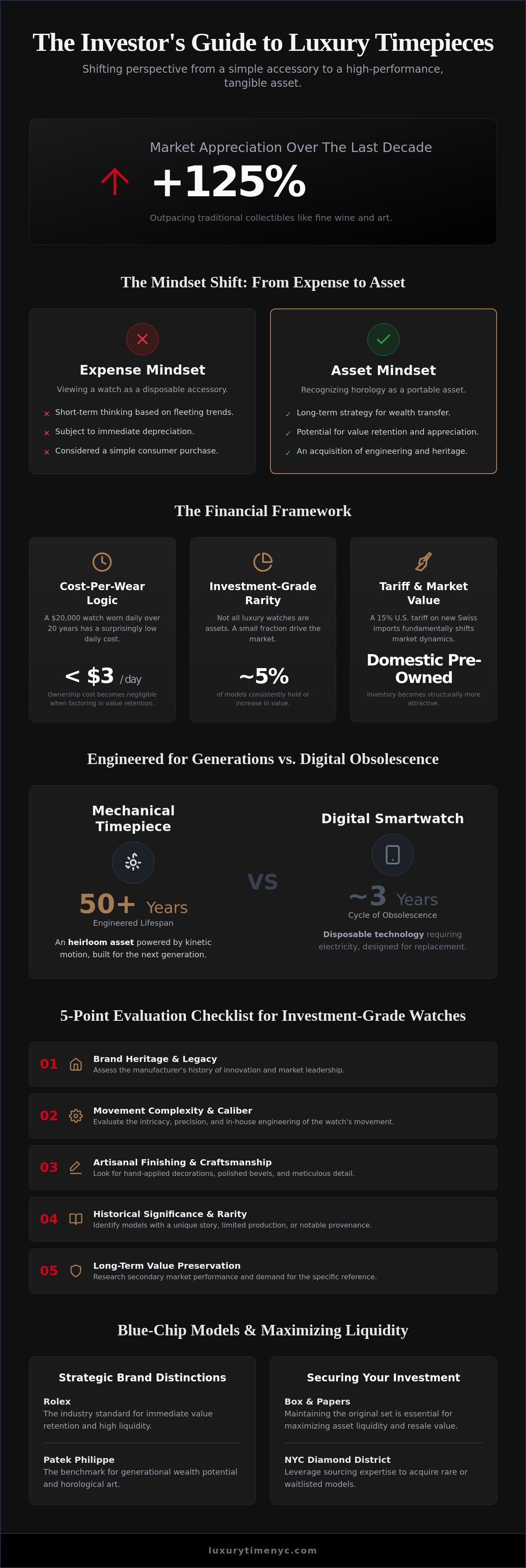
Luxury watches have appreciated by approximately 125 percent over the last decade. This performance outpaces traditional collectibles like fine wine and art, yet the weight of a five-figure investment often invites hesitation. You appreciate the heritage of a masterfully engineered movement, but the fear of immediate depreciation can be a significant barrier. Learning how to justify buying an expensive watch requires a shift in perspective. It's the transition from viewing a timepiece as a mere accessory to recognizing it as a high-performance asset.
We'll provide the logical and financial frameworks that define a strategic acquisition. This includes understanding the cost-per-wear logic and the impact of the 15 percent tariff on new Swiss imports, which has fundamentally shifted the value of the domestic pre-owned market. You'll discover how to identify investment-grade pieces from manufacturers like Patek Philippe and Rolex with absolute confidence. This guide serves as your gateway into a world where mechanical art meets financial security, offering the clarity needed to build a collection of enduring significance.
Key Takeaways
- Transition from consumption to curation by viewing mechanical horology as engineering art rather than a simple accessory.
- Learn how to justify buying an expensive watch by applying a wealth-transfer framework that treats horological excellence as a portable and liquid asset.
- Utilize a 5-point evaluation checklist to assess brand heritage and movement complexity, ensuring every acquisition meets investment-grade standards.
- Identify the strategic distinctions between the value retention of Rolex and the generational wealth potential of Patek Philippe.
- Leverage the liquidity and sourcing expertise of the NYC Diamond District to secure rare or waitlisted models through professional consultations.
The Psychology of Acquisition: Why We Seek Horological Excellence
The act of purchasing a timepiece is often misunderstood by the uninitiated as a simple transaction. For the connoisseur, it's a deliberate transition from consumerism to curation. Understanding how to justify buying an expensive watch begins with recognizing the difference between an expense and an acquisition. You aren't merely buying a tool to tell time. You're securing a legacy piece that represents centuries of mechanical evolution. This psychological shift transforms the buyer into a guardian of heritage. It is a movement from the temporary to the eternal.
A mechanical movement is engineering as art. Unlike the sterile glow of a digital screen, these intricate calibers represent a pursuit of horological excellence that remains unmatched by modern silicon. This commitment to precision serves as a discreet billionaire’s handshake. It signals a shared appreciation for tradition and excellence without a single word being spoken. It's the mark of a collector who values substance over hype. This quiet confidence defines the elite collector. The transition into this world involves several key psychological milestones:
- Recognition of artisanal finishing and hand-applied decorations.
- Appreciation for the historical significance of specific complications.
- Commitment to long-term value preservation over short-term trends.
Mechanical Longevity vs. Digital Obsolescence
Smartwatches operate on a three year cycle of planned obsolescence. They are disposable technology. In contrast, a Rolex is engineered to function for 50 years or more. Professional maintenance ensures it remains accurate for decades. This creates the Heirloom Factor. You're buying for the next generation. These pieces are inherently sustainable. They require no electricity. They rely solely on the kinetic energy of your motion. It's a permanent machine in a world of temporary gadgets. When you consider how to justify buying an expensive watch, the longevity of mechanical engineering provides a clear, logical foundation for the investment.
The Emotional ROI of Craftsmanship
The tactile experience of a hand-finished Patek Philippe is transformative. You can feel the weight of history. Every polished bevel and hand-engraved bridge tells a story of human mastery. Wearing a piece of history changes your daily perspective. It reminds you that excellence is a slow, deliberate process—a level of artistry also found in the luxury performances of Catwalk Opera. This emotional return on investment is both immediate and enduring. Horological value is the precise intersection where rarity meets mechanical precision.
The Financial Framework: Watches as Tangible Assets
Wealth transfer is a sophisticated strategy. It moves capital from depreciating currency into portable, liquid assets. In 2026, the U.S. tariff on Swiss imports is 15 percent. This reality makes existing domestic inventory structurally more attractive than new imports. You aren't simply spending money. You're shifting it into a tangible form. The Psychology of Acquisition suggests that elite collectors seek assets that offer both aesthetic utility and long term value retention.
Historical data confirms the strength of this asset class. According to the Knight Frank Luxury Investment Index, luxury watches appreciated approximately 125 percent over the last decade. This performance outpaces many traditional indices. When you consider how to justify buying an expensive watch, the cost-per-wear logic is undeniable. A 20,000 dollar acquisition worn daily over 20 years costs less than three dollars a day. If that piece retains 80 percent of its market value, the actual cost of ownership becomes negligible. It's a hedge against inflation in a volatile economy.
Value Retention and the Secondary Market
Specific models trade above retail price immediately upon acquisition. This phenomenon occurs because demand chronically exceeds supply. Authenticity remains the bedrock of this value. Maintaining the original box and papers is essential for maximizing asset liquidity and resale potential. To understand the complexities of the current market, consult our guide on The Best Place to Sell Watches in 2026.
The 'Safe Haven' Models
Not all timepieces are financial assets. Only about 5 percent of luxury watches consistently hold or increase in value. Identifying these 'Blue Chip' models is critical for any serious collector. Common high performers include:
- The Rolex Daytona: A global benchmark for value retention.
- The Patek Philippe Nautilus: The definitive symbol of generational wealth.
- The Rolex Submariner: High liquidity and universal recognition.
Production caps and brand heritage drive this long term appreciation. Professional sourcing is the only way to secure these investment grade examples. A private consultation at our Diamond District showroom provides the security needed for these high value transactions.
How to Justify the Purchase: A 5-Point Evaluation Checklist
Moving from the abstract value of timepieces to a concrete acquisition requires a disciplined vetting process. A random purchase is a gamble. A curated acquisition is a strategy. To understand how to justify buying an expensive watch, you must apply a rigorous framework that separates temporary fashion from enduring mechanical assets. This checklist ensures your capital is placed in a vehicle of true horological significance.
- Assess the Brand Heritage: Prioritize manufacturers with a century of uninterrupted history. Names like Patek Philippe and Rolex carry a legacy that secures their market position through various economic cycles.
- Evaluate the Movement: Seek in-house calibers. Proprietary engineering represents a higher level of technical investment and intellectual property than generic, outsourced movements found in entry level pieces.
- Analyze the Scarcity: High production numbers dilute rarity. Focus on models where demand consistently outpaces supply. This creates a natural floor for the asset's value.
- Verify the Provenance: Secure your investment through a reputable NYC institution. A Diamond District veteran provides the necessary authenticity guarantees that private, unverified sellers simply cannot match.
- Consider the Serviceability: An asset is only as good as its longevity. Ensure the piece can be maintained by experts using factory original components for decades to come.
Understanding Horological Complications
Mechanical complexity directly influences rarity. High complications like perpetual calendars and tourbillons require hundreds of hours of manual assembly by master watchmakers. These features justify a higher entry price by transforming the watch into a feat of micro engineering. A complication is a silent testament to human mastery over the progression of time itself. These pieces often represent the pinnacle of a manufacturer's capability. They remain highly sought after by serious collectors who understand how to justify buying an expensive watch based on technical merit.
The Importance of Physical Condition
Condition is the ultimate arbiter of value. Original chamfers and unpolished cases are signs of a well preserved asset. Every time a case is polished, metal is removed. This process can soften the sharp lines that define the model's silhouette. Maintaining asset integrity requires access to Professional Watch Repair in NYC. Factory original parts remain the gold standard for any justification. A pristine, unmolested example will always command a premium over a compromised piece, regardless of its rarity.
Strategic Model Selection: Where Logic Meets Desire
Strategic model selection is where the cold logic of market performance meets the heat of personal desire. In the 2026 climate, where retail prices for brands like Rolex rose by an average of 7 percent on January 1, choosing the right model is a calculated maneuver. It's the difference between a depreciating accessory and a high-performance asset. Understanding how to justify buying an expensive watch requires a tiered approach to the global brand hierarchy.
Rolex serves as the ultimate entry point. It offers unparalleled global recognition and a secondary market that functions with the efficiency of a major stock exchange. Patek Philippe represents the pinnacle of generational wealth. These pieces often see exceptional high-auction performance, particularly for rare complications that appreciate over decades. Audemars Piguet occupies the intersection of avant-garde design and elite social signaling. The Royal Oak remains a cornerstone of this cultural and financial identity. For the modern era, Richard Mille provides the technical 'Billionaire’s Handshake.' It utilizes materials from aerospace and Formula 1 to create a new category of horological excellence that commands respect in every boardroom.
The Rolex Advantage in NYC
Within the historic Diamond District, the Rolex Submariner remains the most justifiable first purchase. Its liquidity is absolute. You can trade or sell a Submariner on West 47th Street with remarkable speed and price transparency. This accessibility is a core component of its value. For those entering the market, The Essential Guide to Buying a Rolex in NYC provides the necessary roadmap for a secure, investment-grade acquisition.
Patek Philippe: The Investment of Kings
The philosophy that you never actually own a Patek Philippe is a financial reality. You are securing an asset for the next generation. The resale dynamics between specific models are distinct. While the Calatrava offers a classic entry into the brand's heritage, the Nautilus remains a powerhouse of market performance. Production caps ensure these pieces remain elusive and highly sought after. Serious collectors should review our Patek Philippe New York: Acquisition Guide to navigate the nuances of this elite market.
Our curated inventory at Luxury Time NYC offers direct access to these strategic assets through a private showroom consultation.
The NYC Diamond District: Securing Your Investment
West 47th Street is more than a destination. It is a global epicenter for horological liquidity. With an estimated 400 to 500 million dollars in transactions occurring daily, this historic corridor provides the market depth required to treat a timepiece as a high-performance asset. Accessing this level of liquidity is a fundamental component in how to justify buying an expensive watch. In a market where 90 percent of diamonds entering the United States pass through this single district, the concentration of expertise is absolute. You aren't just buying a product. You're entering a professional ecosystem designed for the elite collector.
Independent dealers offer a distinct advantage over traditional boutiques. While authorized retailers are often constrained by waitlists and current production cycles, a Diamond District veteran provides access to discontinued icons and rare, investment-grade models. Luxury Time NYC operates with a commitment to absolute authenticity and discreet service. We understand that a high-stakes transaction requires more than a simple exchange of currency. It requires a private environment where technical details are scrutinized and provenance is verified with clinical precision.
Navigating 47th Street with Confidence
The distinction between a street-level shop and a professional institution is significant. A sophisticated acquisition demands a showroom that functions as a private consultancy. Understanding Navigating 47th Street: The Connoisseur’s Guide is essential for any collector visiting between the standard hours of 10:00 am and 5:00 pm. Look for definitive authenticity guarantees presented as absolute facts. These documents are the bedrock of your investment's future value.
Post-Purchase Peace of Mind
Securing an investment doesn't end at the point of sale. Long-term value retention depends on professional maintenance within a certified horological service center. In-house movement overhauls and pressure testing ensure your asset remains in factory-original condition. This technical support is vital for preserving the mechanical integrity of pieces from Patek Philippe or Rolex. A relationship with an established NYC dealer is your best asset for future trades. It provides a seamless path for upgrading your collection as the market evolves. To begin your journey with a partner who values excellence above all else, schedule a private consultation at our NYC showroom.
Cultivating a Legacy of Horological Excellence
A luxury watch is a strategic pivot into tangible wealth. It bridges the gap between mechanical mastery and financial security. By focusing on high-performance models and understanding the structural advantage of the 15 percent tariff on new Swiss imports, you transform a purchase into a preservation of capital. Learning how to justify buying an expensive watch is an exercise in identifying enduring value. It's the transition from mere ownership to the curation of a private legacy.
Security in this high-stakes market requires a partner with deep industry knowledge. Our discreet showroom in the NYC Diamond District offers expert sourcing for rare models and a definitive Certified Authenticity Guarantee. We invite you to Explore Our Curated Collection of Investment-Grade Timepieces and experience the quiet confidence that comes with professional horological advisory. Your journey into the world of timeless engineering begins with a single, calculated acquisition. Step into a world where excellence is the only standard.
Frequently Asked Questions Regarding Luxury Watch Acquisitions
Is a luxury watch really a better investment than the stock market?
Luxury watches can outperform traditional indices, as evidenced by the 125 percent appreciation of the asset class over the last decade. While the stock market offers high liquidity, a timepiece provides a tangible hedge against inflation. It's a portable asset that maintains value through economic volatility. Diversifying into horological assets adds a layer of physical security to a sophisticated investment portfolio.
How much should I spend on my first expensive watch?
Entry level luxury timepieces typically require an investment between 4,000 and 7,000 dollars in 2026. For those seeking investment grade assets with high appreciation potential, the threshold generally begins at 20,000 dollars. Your budget should align with your specific goals for value retention. A higher initial outlay for a 'Blue Chip' model often results in a lower total cost of ownership over time.
What brands hold their value best in 2026?
Rolex, Patek Philippe, and Audemars Piguet remain the dominant forces for value retention in 2026. These manufacturers consistently command high prices on the secondary market due to chronic supply shortages and centuries of brand heritage. The permanent 15 percent tariff on new Swiss imports has further bolstered the value of existing domestic inventory from these prestigious houses.
Why is a mechanical watch more expensive than a superior quartz watch?
A mechanical watch is a pursuit of engineering as art, designed to last for generations with proper maintenance. Quartz movements rely on disposable electronic components with limited lifespans. The higher price reflects hundreds of hours of manual assembly and hand-applied finishing. You're investing in a permanent machine that requires only human motion to function, rather than a temporary electronic gadget.
Should I buy new or pre-owned to justify the cost?
Buying pre-owned is often the most logical way to justify the cost of a luxury acquisition. New retail purchases can lose 20 to 40 percent of their market value immediately upon leaving the boutique. By acquiring a pre-owned piece from a reputable NYC institution, you bypass this initial depreciation. This strategy allows you to secure an asset that has already stabilized in market price.
How can I be certain a watch in the Diamond District is 100% authentic?
Authenticity is guaranteed by the reputation and professional standards of established Diamond District institutions. Luxury Time NYC provides certified authenticity guarantees presented as absolute facts. We utilize in-house horological experts to verify every component. Securing your investment through a veteran dealer ensures you receive a factory-original piece with full provenance and no technical compromises.
What is the 'Cost per Wear' of a Rolex Submariner?
The cost-per-wear of a Rolex Submariner is remarkably low when calculated over a 20 year horizon. If a collector wears a 15,000 dollar piece daily, the daily cost is approximately two dollars. Because the model often retains 80 percent or more of its value, the actual financial impact of ownership is negligible. This remains a primary reason for how to justify buying an expensive watch.
Does polishing a luxury watch hurt its resale value?
Aggressive polishing can significantly diminish the resale value of a luxury timepiece. Collectors prioritize original chamfers and sharp, unpolished case lines that reflect the factory finish. Every polishing cycle removes a microscopic layer of metal, which can soften the watch's intended silhouette. We recommend only professional horological servicing to preserve the mechanical integrity and aesthetic value of your asset.


