


Rolex implemented a 7% price increase on January 1, 2026, instantly recalibrating the value of many private collections. For the discerning owner, this shift highlights a critical decision regarding liquidity. The choice between consignment vs direct sale for luxury watches is a strategic crossroad. It's the difference between immediate capital and a meticulously maximized return. You deserve a transition that reflects the prestige of the items themselves. Absolute security. Professional discretion. We understand the frustration of undervalued offers and the anxiety of unsecured transit.
Your timepieces are enduring assets, not mere accessories. This guide provides the technical insight required to evaluate the $35.7 billion pre-owned market with confidence. You'll learn how to weigh the rapid execution of a direct sale against the premium potential of consignment. We'll examine current trends, including the rise of the considered collector and the impact of market normalization, to ensure your next move is as precise as a Swiss caliber.
Key Takeaways
- Distinguish between immediate liquidity and strategic asset optimization to align your exit with your current capital requirements.
- Master the choice of consignment vs direct sale for luxury watches based on the market demand and rarity of your specific model.
- Secure your investment through professional authentication and high-security NYC vaulting. Absolute protection. Total discretion.
- Navigate complex commission tiers and dealer margins to ensure your financial return reflects the true heritage of the piece.
- Access an elite global network from the New York Diamond District to connect your timepiece with serious collectors.
Defining the Secondary Market: Consignment vs. Direct Sale
The secondary market for high-horology assets reached a valuation of USD 35.7 billion in 2026. This scale demands a sophisticated approach to divestment. For the serious collector, the decision between consignment vs direct sale for luxury watches is a fundamental choice between immediate liquidity and strategic asset optimization. It's a calculated move. Every reference in your collection represents a specific intersection of heritage and capital. How you choose to exit that position determines your ultimate ROI.
Market normalization in 2026 has introduced a new layer of complexity. With Rolex prices increasing by an average of 7% on January 1st, the underlying value of your inventory is dynamic. Buyers are more disciplined. They prioritize authenticity and service history over speculative trends. Choosing the right path requires an understanding of how these mechanisms operate within the current economic climate. Precision is paramount.
The Direct Sale Mechanism
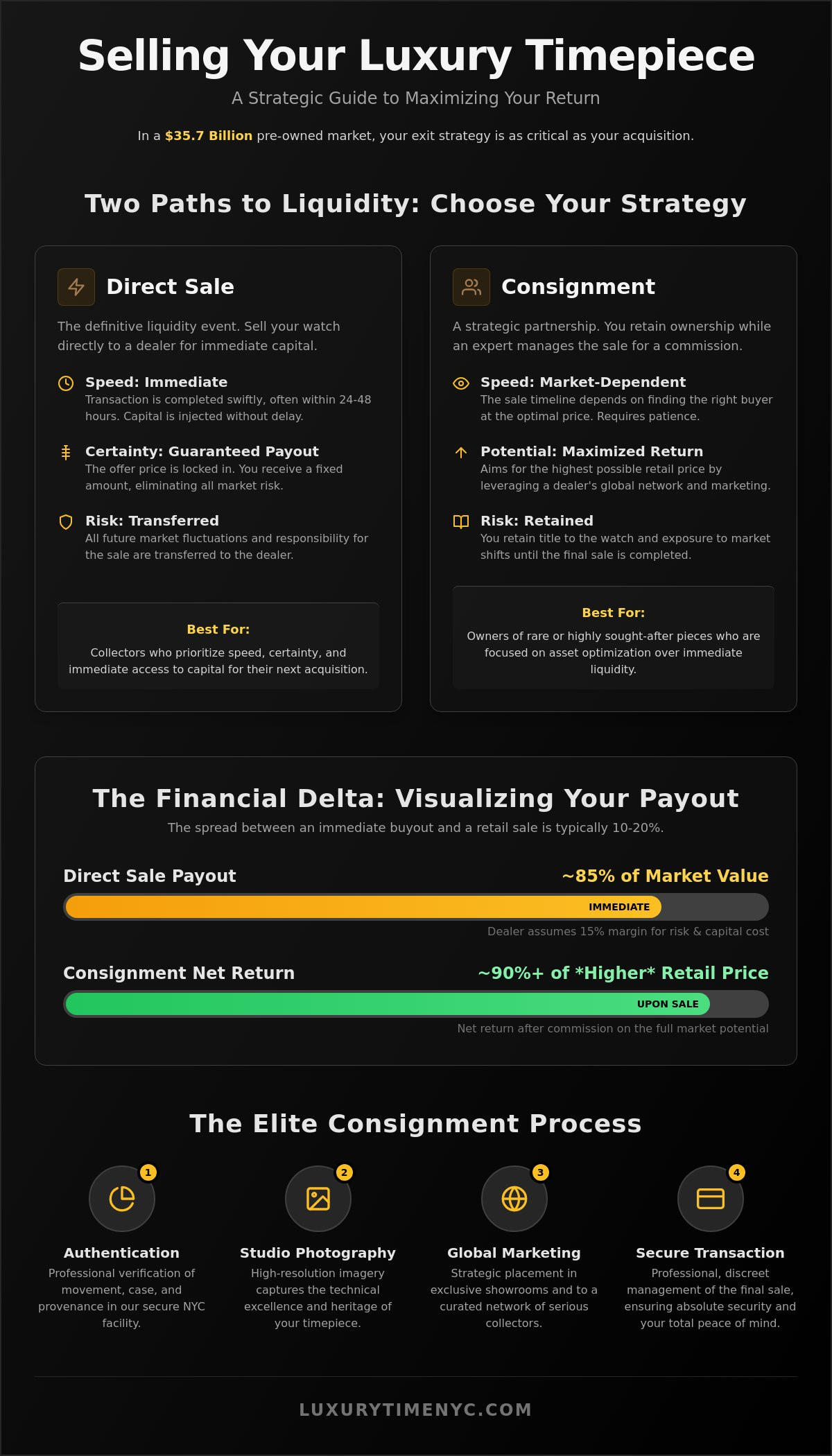
A direct sale is a definitive liquidity event. In this model, the dealer purchases the timepiece directly for their own inventory. The transaction is swift. The capital injection is immediate. This approach is ideal for collectors who prioritize speed or have already identified their next acquisition. When you sell directly, you transfer all future market risk to the dealer. If the market for a specific reference softens tomorrow, your capital is already secured. It's a clean, no-strings-attached solution for liquidating a single piece or an entire collection. You trade a portion of the potential retail upside for the certainty of now.
The Consignment Architecture
Consignment is a collaborative brokerage agreement. You retain legal title to the watch while a professional institution manages the sale on your behalf for a commission. This method leverages the dealer's global network, marketing expertise, and prestige to find the right buyer at the right price. It's an exercise in patience and market positioning.
The process is deliberate and meticulous. At an elite level, it includes several value-added pillars:
- Professional white-glove authentication to verify the integrity of the movement and case.
- Exquisite high-resolution photography that highlights technical excellence and emotional heritage.
- Strategic placement within exclusive showrooms in global commerce centers like New York.
- Access to a curated database of high-net-worth individuals and serious collectors.
The trade-off is time. Achieving a "top of market" price requires a longer horizon. However, for investment-grade complications where the delta between a quick buyout and a retail sale is significant, consignment remains the preferred strategy. Understanding the nuances of consignment vs direct sale for luxury watches ensures your collection remains a source of enduring strength rather than a static holding.
The Financial Delta: Payouts, Commissions, and ROI
The financial architecture of a divestment strategy is rarely linear. When evaluating consignment vs direct sale for luxury watches, the primary variable is the "delta"—the spread between an immediate buyout and an eventual retail realization. In the modern pre-owned watch market, this spread typically ranges from 10% to 20%. This margin represents the dealer's assumption of risk and the cost of capital. A direct sale provides certainty. Consignment provides optimization. Each path serves a distinct purpose within a broader collection strategy.
Direct Sale Valuation Factors
Dealers calculate their bid based on current inventory turnover rates and the specific demand within the NYC Diamond District. When comparing consignment vs direct sale for luxury watches, a direct offer is governed by the "buy-box." If a reference is highly liquid, such as a Rolex Submariner, the margin requirements are tighter. The offer is a reflection of real-time liquidity. Provenance is critical. A full set—original box, papers, and documented service history—can command a significant premium even in a rapid buyout scenario. Without these, a dealer must account for the cost of sourcing replacements or performing a professional watch authentication.
Consignment Fee Structures
Consignment shifts the financial focus from speed to net return. Standard industry commissions cover the administrative burden of high-end commerce. This includes secure storage, global marketing, and professional presentation. Elite institutions offer transparency. There aren't hidden fees for photography or insurance. A "net to seller" agreement is often the most sophisticated choice. It establishes a fixed payout upon sale, removing the ambiguity of percentage-based fluctuations. This clarity allows you to treat your timepiece as a fixed asset with a known future value. It's a structured approach to maximizing ROI.
The "Cost of Time" is the final metric. Is a 20% higher payout worth a 90-day wait? For a high-complication Patek Philippe, the answer is usually yes. The market for such pieces is thin. It requires a curated approach to find the right connoisseur. For those seeking a seamless transition between assets, we invite you to explore our bespoke acquisition services. Your collection's value remains our priority. Precision in strategy matches precision in engineering.
Mitigating Risk: Security, Insurance, and Authenticity
Trust is the silent currency of the secondary market. When weighing consignment vs direct sale for luxury watches, security shouldn't be a variable. It must be an absolute. Handing over a high-complication timepiece or a rare reference requires more than a handshake; it requires an escrow mindset. You are not simply leaving a watch with a dealer. You are placing a protected financial asset into a secure pipeline. In 2026, the complexity of global logistics and the rise of sophisticated replicas make this phase of the transaction the most critical for any serious collector.
Physical security remains the bedrock of this trust. In the high-stakes environment of the NYC Diamond District, protection is multi-layered. Your asset resides within reinforced vault storage, monitored by 24/7 surveillance and biometric access controls. This level of oversight is non-negotiable. Furthermore, full-value insurance coverage must be in effect from the moment the timepiece leaves your possession until the final sale is settled. A formal consignment agreement serves as your legal safeguard. It outlines the precise terms of the arrangement, ensuring your interests are shielded throughout the brokerage period.
The Authentication Barrier
A definitive condition report is your first line of defense. Before a watch enters a showroom, it undergoes a rigorous technical evaluation. Leveraging deep watch repair nyc expertise allows for an internal inspection that prevents "part swapping" fraud and verifies every component. This technical mastery does more than protect the seller; it accelerates the sale. When a buyer knows a movement has been professionally vetted and overhauled, their confidence increases. Total transparency leads to faster liquidity. You deserve a partner who acts as a guardian of authenticity, ensuring the heritage of your piece remains untarnished.
Dealer Reputation and Longevity
Showroom presence in a global center of commerce provides a level of accountability that digital-only platforms cannot match. A physical institution in New York carries the weight of local authority and global reach. When evaluating consignment vs direct sale for luxury watches, consider the "Consignor's Bill of Rights." This includes:
- Right to a detailed, photographic condition report.
- Right to proof of full-value insurance coverage.
- Right to a transparent, fixed-fee commission structure.
- Right to immediate payment notification upon sale completion.
Vetting a dealer's longevity is essential. You're looking for a peer who understands that these items are enduring assets. A professional advisor doesn't just market a product; they curate a legacy. By demanding these standards, you ensure your exit strategy is as sophisticated as the collection you've built.
Maintaining a collection of this caliber requires meticulous documentation and physical organization; for collectors who need professional inventory management tools, you can learn more about DymoOnline for specialized labeling resources.
A Strategic Framework: Which Method Suits Your Timepiece?
Not every reference follows the same path to liquidity. The choice of consignment vs direct sale for luxury watches is dictated by the depth of the buyer pool and the rarity of the caliber. High-volume models benefit from the speed of a buyout. Rare complications require the reach of a curated network. Your strategy should reflect the specific technical gravity of your asset. Precision is the standard.
The Rolex Strategy
Modern professional models are essentially liquid currency. For a stainless steel Submariner or GMT-Master II, a direct sale is often the most efficient path. Dealer margins are historically tight on these references due to high turnover. You trade a small percentage of retail value for the certainty of immediate capital. Vintage references require more nuance. A four-digit Daytona or a tropical-dial Sea-Dweller shouldn't be rushed. These pieces deserve the patient exposure of consignment to find the right connoisseur. In the 2026 market, 'New Old Stock' (NOS) Rolex models consistently command a premium of 15% to 25% over standard pre-owned examples as collectors prioritize untouched factory finishes.
The Patek & AP Strategy
Blue-chip complications from manufacturers like Patek Philippe New York demand a storytelling approach. These aren't just timepieces; they're historical records. Consignment is the superior choice for a Nautilus or a Royal Oak Perpetual Calendar. It allows a dealer to leverage their reputation to reach the global 1%. Provenance is the catalyst for value here. A documented history of ownership can elevate a sale price far beyond a standard buyout offer. Using current buy and sell watches data ensures you're entering the market at the peak of demand.
Niche independent brands also thrive in a consignment environment. References from Richard Mille or limited Cartier collections require a specialist's curated audience. If your goal is to optimize the exit of a rare complication, consult with our acquisition team to determine the ideal path for your specific reference. This tailored approach respects both the asset and the collector.
The Luxury Time NYC Advantage: Global Reach, Local Authority
Selecting between consignment vs direct sale for luxury watches requires more than a cursory market glance. It requires a partner with the institutional weight to execute either strategy with absolute precision. Luxury Time NYC operates as a market maker in the most literal sense. We don't just facilitate transactions; we provide the liquidity and authority required to move high-value assets in a normalizing 2026 market. Our hybrid approach allows for a bespoke solution tailored to the specific reference in your possession. Market makers. Guardians of heritage. Discreet advisors.
Our advantage lies in our curated database of high-net-worth collectors. These individuals aren't just browsing; they're actively seeking rare inventory to round out serious collections. When you partner with us, your timepiece is presented to a global audience that understands the technical gravity of a Patek Philippe or a Richard Mille. This isn't mass-market exposure. It's a targeted, elite placement designed to find the perfect buyer for your asset.
Why 47th Street Matters
Velocity defines the Diamond District. By leveraging the high-velocity traffic of 47th street new york watches, we ensure your timepiece receives maximum visibility from serious collectors and trade professionals alike. This physical presence creates a powerful synergy with our digital global marketplaces. It's a dual-layered exposure that digital-only platforms simply cannot replicate. We provide the local authority that global HNW collectors demand when acquiring rare inventory.
In this environment, time is a luxury. Being situated in the heart of the world's watch capital allows us to gauge market sentiment in real-time. We see the shifts before they become statistics. This proximity allows us to advise you with a level of accuracy that outsiders lack. We aren't just observers; we're participants in the ongoing heritage of horology. Your asset benefits from the prestige of our location and the depth of our industry knowledge.
Your Private Consultation
Exclusivity is our standard. Every engagement begins with a private consultation where we analyze your asset's technical condition, provenance, and current market demand. We don't push a single method. We recommend the path that aligns with your specific financial goals and collection strategy. Our commitment to transparency is absolute. From the initial quote to the final settlement, every step is documented and clear.
The process is designed for the modern collector who values discretion above all else. We handle the complexities of insurance, authentication, and global logistics, allowing you to focus on the next stage of your collection. Experience the Luxury Time NYC difference—request your valuation today.
Strategizing Your Collection’s Next Chapter
Liquidity is the final measure of a successful collection strategy. Whether you prioritize the immediate capital of a direct buyout or the optimized return of an elite brokerage agreement, your decision should reflect the technical gravity of the timepiece. The choice between consignment vs direct sale for luxury watches isn't merely a financial transaction. It's a statement of how you value the heritage of your horological assets. Precision in timing. Absolute security in execution.
Luxury Time NYC has served as a guardian of authenticity since 2005. From our Diamond District showroom, we provide the global reach and local authority required to navigate a normalizing market with confidence. Every piece we handle is backed by a definitive Global Authenticity Guarantee. You deserve a partner who speaks the language of fine engineering and respects the discretion your lifestyle demands. Your next move should be as calculated as a perpetual calendar. Secure Your Valuation: Sell or Consign with Luxury Time NYC. We look forward to curating your legacy.
Frequently Asked Questions
Is consignment safer than selling my watch directly?
Safety is defined by the reputation of the institution rather than the selling method itself. A direct sale offers immediate finality, which reduces the duration of your asset's exposure. Consignment relies on a protected pipeline of high-security vaulting and professional oversight. Both paths at Luxury Time NYC include 24/7 surveillance and biometric access to ensure your investment remains an absolute priority.
How long does the average luxury watch take to sell on consignment in 2026?
Market data from 2026 suggests an average window of 60 to 120 days for a successful consignment sale. Highly liquid references from Rolex often move closer to the 30-day mark due to constant demand. Rare complications from Patek Philippe require the deliberate pace of a curated search to find a connoisseur willing to pay a premium for heritage and condition.
What percentage do watch dealers typically charge for consignment?
Industry averages for consignment commissions generally range from 10% to 30% of the final sale price. This fee covers global marketing, professional photography, and full insurance coverage. When weighing consignment vs direct sale for luxury watches, consider that these fees are an investment in achieving a retail-level realization that consistently exceeds a standard dealer buyout offer.
Can I get my watch back if it doesn't sell on consignment?
You retain legal title to your timepiece throughout the entire consignment period. If a sale isn't realized within the timeframe specified in your agreement, the asset is returned following a final technical verification. This ensures your collection remains under your ultimate control while you leverage our global reach. It's a transparent process designed for the modern collector's peace of mind.
Does Luxury Time NYC offer immediate cash for Rolex and Patek Philippe?
We provide competitive direct buyouts for high-liquidity models from Rolex, Patek Philippe, and Audemars Piguet. This option is designed for collectors seeking an immediate capital injection for their next acquisition. It's a definitive liquidity event that bypasses the waiting period associated with brokerage. Our offers reflect real-time Diamond District data and the technical excellence of your specific reference.
What happens if my watch is damaged or stolen while on consignment?
Your timepiece is shielded by full-value insurance from the moment of intake until the final settlement. In the rare event of transit damage or showroom loss, the insurance policy ensures your financial position is fully protected. Security is multi-layered. We treat every consigned item as a protected financial asset, housed within reinforced vaults in our high-security Manhattan showroom.
Do I need to service my watch before selling it or consigning it?
A recent movement overhaul or professional polish isn't mandatory, but it significantly enhances buyer confidence and sale speed. We perform a rigorous technical evaluation and watch authentication upon arrival. If maintenance is required to maximize your ROI, our specialists provide tailored recommendations. Provenance and service history are the catalysts for achieving top-of-market value in any transaction.
How do you determine the market value for a direct sale offer?
Valuation is a synthesis of technical condition, provenance, and real-time Diamond District demand. We act as market makers, using proprietary data to ensure your offer reflects the true global value of the caliber. In the choice of consignment vs direct sale for luxury watches, our offers are presented as absolute facts rooted in deep industry knowledge and current inventory turnover rates.


