


Why does a Patek Philippe Ref. 5711 retain its gravity while other luxury timepieces see their value evaporate the moment the warranty card is stamped? Understanding watch market depreciation is the essential filter that separates impulsive purchases from true horological investments. For the serious collector, a watch is never just an accessory. It's a store of value, a piece of engineering history, and a testament to enduring craftsmanship.
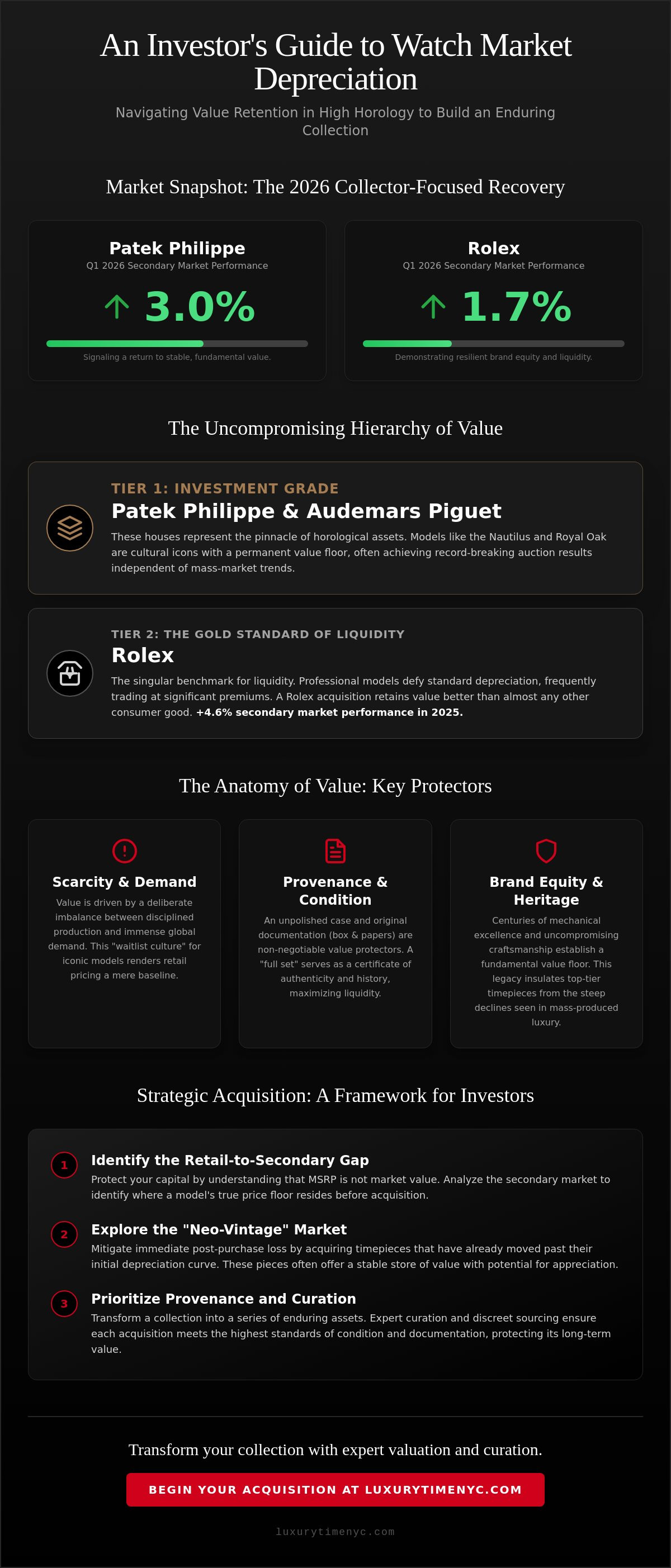
You've likely felt the unease of fluctuating grey market prices or the fear of a significant capital loss on a high-five-figure acquisition. It's a valid concern in a market that saw a sharp correction in 2022, yet the gentle recovery of early 2026 proves that quality remains resilient. Rolex prices rose 1.7% in the first quarter of this year, while Patek Philippe saw a 3.0% increase, signaling a return to a stable, collector-focused economy. This shift rewards those who prioritize heritage over hype.
We'll provide the clarity you need to curate a collection that holds its own against time. You'll master the mechanics of value retention, from the impact of manufacturer scarcity to the rise of the "True Collector" era. This guide offers a strategic framework to evaluate any potential acquisition, ensuring your next timepiece is as much a financial asset as it is a mechanical masterpiece.
Key Takeaways
- Identify the specific mechanics behind the retail-to-secondary price gap to protect your capital from immediate post-purchase losses.
- Refine your acquisition strategy by understanding watch market depreciation and why the "Big Three" manufacturers continue to dominate value retention.
- Recognize the critical importance of provenance and condition, where original documentation and unpolished cases serve as essential value protectors.
- Explore the strategic advantages of the "Neo-Vintage" market to secure timepieces that have already moved past their initial depreciation curve.
- Learn how expert curation and discreet sourcing in New York can transform a collection into a series of enduring horological assets.
The Mechanics of Watch Depreciation: Why Value Fluctuates
Watch depreciation is the delta between primary acquisition cost and secondary market liquidity. For the novice, this gap often mirrors the "drive-off-the-lot" effect seen in luxury automobiles. However, for the connoisseur, understanding watch market depreciation is less about inevitable loss and more about identifying where the price floor resides. While mass-produced items face a steep decline, investment-grade timepieces from houses like Patek Philippe or Rolex operate under different laws of physics. They are enduring assets; they are mechanical legacies.
The 2026 pricing landscape represents a significant shift from the speculative frenzy of years past. Following the correction that began in 2022, the market has transitioned into a stable, collector-focused economy. Data from early 2026 shows a gentle recovery. Rolex values rose 1.7% and Patek Philippe climbed 3.0% in the first quarter alone. This isn't accidental. It's the result of fundamental brand equity asserting itself after the exit of short-term speculators. A watch's value is deeply tied to the History of watches and their evolution from mere tools into portable stores of wealth. Brand equity establishes a floor that prevents high-end pieces from ever hitting zero.
The MSRP vs. Secondary Market Reality
Paying retail price rarely equates to establishing true market value. In the world of high horology, MSRP is often a baseline that ignores the reality of "waitlist culture." For iconic models from Audemars Piguet or Richard Mille, the secondary market often commands a premium that renders retail pricing irrelevant. Conversely, brand-driven price increases at the boutique level often pull up the value of older, discontinued models. It's a symbiotic relationship. The primary market's inflation protects the secondary market's floor.
Economic Factors Influencing Luxury Assets
High-end watches don't exist in a vacuum. Interest rates have a surprising correlation with liquidity. When rates are high, the opportunity cost of holding non-yielding assets increases, often cooling the market. Yet, these items frequently behave as Veblen Goods. In this paradox, higher prices can actually increase demand by reinforcing the item's status as a rare, exclusive asset. Global currency fluctuations also play a role. A strong Swiss franc often necessitates retail price hikes, which indirectly bolsters the value of pre-owned inventory in New York and other global commerce centers.
The Brand Hierarchy: Who Holds Value and Why
The hierarchy of horological value is steep and uncompromising. While many manufacturers produce exceptional timepieces, only a select few consistently defy the gravity of the secondary market. Mastery of this hierarchy is the cornerstone of understanding watch market depreciation. Patek Philippe. Audemars Piguet. Rolex. These names define the ceiling of the market. Their dominance isn't merely a result of marketing; it's a reflection of disciplined production and centuries of mechanical excellence.
Rolex: The Gold Standard of Liquidity
Rolex remains the singular benchmark for liquidity in the global market. A Rolex nyc acquisition often retains value better than almost any other consumer good. In 2025, the brand saw a 4.6% increase in secondary market performance, a testament to its enduring appeal. Professional models like the GMT-Master II "Pepsi" or the Cosmograph Daytona frequently trade at significant premiums over their retail price. These models defy standard depreciation curves due to a deliberate imbalance between supply and global demand. Classic models, while generally more accessible, still provide a formidable price floor compared to fashion-driven alternatives.
Patek Philippe and Audemars Piguet: The Investment Grade
For the serious collector, Patek Philippe and Audemars Piguet represent the pinnacle of investment-grade horology. The Nautilus and Royal Oak have moved beyond being simple watches; they are cultural icons with a permanent value floor. Recent data from the Swiss luxury watch market highlights a divergence between mass-market trends and record-breaking auction results for these houses. In 2025, Patek Philippe's secondary market performance surged by 12.1%. This growth is fueled by the prestige of Patek Philippe New York provenance and the house's commitment to rarity. While steel sports models remain highly sought after, 2026 is seeing smart money pivot toward high complications, where mechanical artistry offers a unique hedge against market volatility.
The Specialists: Richard Mille and Cartier
Richard Mille exists as a modern exception to traditional rules. Through ultra-scarcity and high-tech materials like TPT carbon, these pieces command prices that reflect their status as racing machines for the wrist. Meanwhile, Cartier is experiencing a significant renaissance. Driven by a renewed appreciation for shaped watches among Gen Z collectors, models like the Tank and Santos are showing remarkable resilience in the 2026 resale market. Their aesthetic individuality provides a refreshing alternative to the standard round case.
If you're looking to refine your portfolio, we invite you to consult our expert guide to acquisition to identify timepieces that consistently outperform market averages.
Scarcity, Condition, and Provenance: The Value Protectors
Scarcity and condition are the invisible pillars that support the secondary market floor. While brand reputation provides the foundation, these specific attributes determine whether a timepiece merely survives or truly thrives. Mastery of these nuances is essential for understanding watch market depreciation. Provenance is the documented history that validates a timepiece’s journey and authenticity. For the serious investor, a watch is more than its movement; it's a record of ownership and care that must be meticulously preserved.
The "Full Set" premium remains a non-negotiable standard for high-stakes acquisitions. In the 2026 market, a watch accompanied by its original box, warranty papers, and hangtags commands a significant premium over "naked" pieces. This documentation acts as a primary defense against market skepticism. Condition grading is equally critical. A single over-polishing by an unskilled technician can erase 20% of a watch’s value by softening the crisp edges of the case or rounding the lugs. Sharp bevels. Factory-correct finishes. Original lume. These are the hallmarks of a value-retaining asset.
Professional maintenance is a prerequisite for long-term liquidity. Utilizing expert watch repair NYC services ensures that every movement overhaul or pressure test is documented and performed to the manufacturer’s exacting standards. Analysis from Why Some Watches Hold Their Value suggests that rarity and unique design features are the primary drivers of long-term appreciation. When maintenance is performed correctly, it doesn't just fix a problem; it protects an investment.
The Perils of Poor Maintenance
Original parts dictate the value ceiling of any high-end timepiece. Dials, hands, and bezels must remain original to the reference; a service dial or modern replacement hands can halve the value of a vintage Rolex or Patek Philippe. While "factory service" offers a guarantee of mechanical perfection, "independent restoration" by a master watchmaker is often preferred by collectors who wish to preserve the original patina and character of the piece. Movement overhauls are an investment in the watch's future resale potential, not merely a maintenance expense.
Scarcity: Artificial vs. Natural
Discontinued models often experience an immediate "pop" in value the moment a reference is retired. However, discerning collectors distinguish between marketing-led "limited editions" and the natural scarcity of low-production references. While limited editions are frequently produced in the thousands, true scarcity is found in "boutique only" editions or high-complication models that are naturally limited by the complexity of their assembly. This natural scarcity creates a permanent imbalance between supply and global demand, insulating the asset from broader market corrections.
Strategic Acquisition: How to Mitigate Depreciation
Strategic acquisition is the connoisseur’s shield against market volatility. While the allure of a boutique-fresh piece is undeniable, the seasoned collector knows that value is often found in the secondary market. By buying pre-owned, you allow the initial owner to absorb the steepest part of the depreciation curve. This approach is particularly relevant in 2026, as the market continues its gentle recovery from the 2022 correction. Understanding watch market depreciation requires a shift in perspective; it's about entering the lifecycle of a timepiece at the point where price and prestige align perfectly.
Focusing on "Neo-Vintage" models—those produced between the 1990s and early 2000s—represents a sophisticated value-play for the current year. These references offer the charm of vintage aesthetics paired with the reliability of modern engineering. They are frequently undervalued compared to their contemporary counterparts, yet they possess the rarity required for future appreciation. Diversifying your portfolio by complication and material, such as acquiring precious metal dress watches alongside high complications, provides a necessary hedge against specific market trends that may favor steel sports models one month and gold references the next.
The "Buy the Seller" Maxim
Authenticity is the only currency that matters in high-stakes horology. A certified authenticity guarantee from a trusted Rolex dealer New York is worth far more than a marginal discount from an unvetted source. The "unvetted" grey market is rife with hidden risks, from counterfeit components to neglected movements requiring immediate, expensive overhauls. At Luxury Time NYC, we vet every piece with a no-nonsense approach to quality. We ensure every acquisition meets the rigorous standards of an established metropolitan institution.
Timing the Market vs. Time in the Market
Horological assets perform best over a long-term horizon. Historically, holding an investment-grade timepiece for 5 to 10 years smooths out short-term volatility. This duration allows the manufacturer's natural retail price increases to pull up secondary market values over time. Identifying "undervalued" references before they reach icon status is the hallmark of a true connoisseur. Whether you're planning an eventual trade-in or a high-stakes consignment, your exit strategy must be as deliberate as your acquisition.
If you're ready to elevate your portfolio with a strategic acquisition, we invite you to explore our curated inventory of investment-grade timepieces today.
The Luxury Time NYC Advantage: Expert Valuation and Curation
Luxury Time NYC stands as a discreet guardian in the heart of the New York Diamond District. We provide the expertise required for understanding watch market depreciation in a landscape that rewards the patient and the informed. Our role is that of a professional advisor. We don't merely facilitate transactions; we curate legacies. By acting as a peer to the elite collector, we offer a gateway into a world where horological passion meets strategic asset management.
We source investment-grade timepieces that frequently defy standard market trends. While the broader market may fluctuate, certain references from Patek Philippe, Rolex, and Audemars Piguet maintain a rhythmic stillness in value. Our commitment is absolute. Every piece undergoes a rigorous authentication process. Absolute authenticity. Uncompromising precision. We ensure that your collection remains a portfolio of enduring assets rather than a series of speculative purchases. Our personalized approach ensures your acquisitions reflect your individual taste while adhering to a strict framework of value retention.
Consignment and Trade-In Excellence
Maximizing your return requires more than just a listing; it requires a global network of elite collectors. We position your timepiece as a masterpiece through professional photography and high-impact marketing. Our process is the best place to sell watches for those seeking maximum liquidity and transparency. We handle the complexities of the international trade, allowing you to transition between assets with confidence. Whether you're trading in a "Neo-Vintage" classic or consigning a high-complication Patek Philippe, our reach ensures your timepiece finds its rightful successor.
Visit Our Diamond District Showroom
The nuance of a high-value acquisition is best appreciated in person. Our Diamond District showroom offers a sanctuary for private consultation and technical evaluation. Here, you can linger over the minute details of a movement or the specific patina of a vintage dial. For our international clientele, we provide secure global shipping that mirrors the exclusivity of our in-person experience. Time is a luxury. We treat it as such. We invite you to schedule a private viewing at Luxury Time NYC to begin the next chapter of your horological journey.
Securing Your Horological Legacy
The pursuit of a fine timepiece is a journey into the heart of mechanical excellence and enduring value. A resilient collection exists at the intersection of brand heritage, meticulous condition, and strategic acquisition. By focusing on the "Big Three" and identifying "Neo-Vintage" opportunities, the sophisticated collector transforms a series of purchases into a curated portfolio of assets. Understanding watch market depreciation is the essential skill that allows you to move with confidence in a fluctuating global landscape.
Prioritizing original provenance and professional maintenance ensures your investment remains as sharp as the day it left the manufacture. Located in the heart of the NYC Diamond District since 2005, Luxury Time NYC remains a guardian of horological integrity. Every timepiece carries a certified authenticity guarantee. Our expert horological service and repair are handled on-site to maintain the highest standards of precision. We invite you to explore our curated collection of investment-grade timepieces. Your next masterpiece is waiting.
Frequently Asked Questions
Do all luxury watches depreciate after purchase?
Not all luxury timepieces lose value; a select group of investment-grade models often trade at significant premiums immediately upon leaving the boutique. While many consumer-facing brands experience an initial decline in value, houses like Patek Philippe and Rolex frequently defy this trend. Understanding watch market depreciation is the essential skill required to identify these resilient outliers and protect your capital from the moment of acquisition.
Which watch brand holds its value the best in 2026?
Patek Philippe currently leads the global market in value retention, showing a 3.0% price increase in the first quarter of 2026. Rolex follows closely with a 1.7% rise during the same period, confirming its status as a pillar of market stability. These manufacturers benefit from disciplined production and a heritage of mechanical excellence that secures their secondary market prices even during broader economic shifts.
How much value does a watch lose without its original box and papers?
A missing "full set" can reduce a timepiece's resale value by 10% to 20% depending on the rarity of the reference. For high-stakes collectors, original documentation is an absolute requirement for verifying provenance and authenticity. The absence of papers often signals a lack of documented history, which significantly lowers the price floor for serious investors who prioritize security and long-term liquidity.
Is a pre-owned Rolex a better investment than a new one?
A pre-owned Rolex is often a superior financial choice because the initial retail-to-secondary depreciation has already occurred. Acquiring a pre-owned piece allows you to enter the market at a point closer to its true liquidity value. This strategy is particularly effective for professional models that have already stabilized, ensuring that your acquisition remains a portfolio asset rather than a depreciating accessory.
Does watch polishing affect the resale value?
Excessive or poor-quality polishing can significantly diminish a watch's value by altering the original factory geometry and softening crisp edges. Collectors prize sharp lugs and original case proportions above all else. While a professional watch polishing service can restore aesthetic appeal, it must be performed with extreme restraint by a master technician to preserve the item's horological integrity and investment potential.
What is the "grey market" and how does it affect watch depreciation?
The grey market refers to authentic timepieces sold through non-authorized channels, which often influences depreciation by increasing the immediate global supply of specific models. While prices in this sector can be lower, they lack the security of a manufacturer warranty. Fluctuations in grey market pricing often serve as a leading indicator for broader market corrections and shifts in collector sentiment.
Can a watch actually increase in value over time?
Certain timepieces do increase in value, particularly when a reference is discontinued or gains significant historical importance. This appreciation is driven by a natural scarcity that creates a permanent imbalance between supply and growing demand. Understanding watch market depreciation helps investors identify the precise point where a timepiece transitions from a standard asset into a rare, appreciating piece of mechanical art.
How often should I service my watch to maintain its market value?
A mechanical timepiece should undergo a professional movement overhaul every five to seven years to ensure its longevity and functional precision. Regular pressure testing is also essential for maintaining the integrity of sports models. A documented service history from a professional facility validates your care as an owner, acting as a critical value protector that reassures future buyers of the watch's condition.


