


The most significant risk in high-end horology isn't a fluctuating market; it's the quiet erosion of provenance. While the pre-owned luxury watch market is projected to reach $30 billion by 2025 according to McKinsey and Company, the path to a secure investment is often obscured by complex terminology and the shadow of sophisticated counterfeits. You understand that acquiring mechanical watches of this caliber requires more than just capital. It requires a discerning eye for craftsmanship and an uncompromising demand for authenticity. Masterpiece engineering. Unrivaled heritage.
You seek a timepiece that serves as both a personal statement and a resilient asset. We'll provide the expert framework necessary to evaluate, select, and invest in the world’s finest horological art. This guide demystifies the acquisition process within the NYC Diamond District, ensuring your next selection holds its prestige for generations. We'll examine the technical markers of a superior caliber, the nuances of secondary market value, and the definitive steps to verify a watch's lineage.
Key Takeaways
- Understand why mechanical watches remain the ultimate horological investment, blending micro-engineered precision with an unrivaled artistic soul.
- Discern the technical and tactile differences between manual-wind and automatic calibers to select a masterpiece that resonates with your personal ritual.
- Learn to evaluate potential acquisitions using the definitive collector’s framework of brand authority, physical condition, and documented provenance.
- Explore the heritage of the 'Holy Trinity'—Patek Philippe, Audemars Piguet, and Vacheron Constantin—to build a world-class collection with confidence.
- Secure your investment by understanding the rigorous multi-point authentication process conducted by our master watchmakers to ensure absolute integrity.
What is a Mechanical Watch? Understanding the Soul of Horology
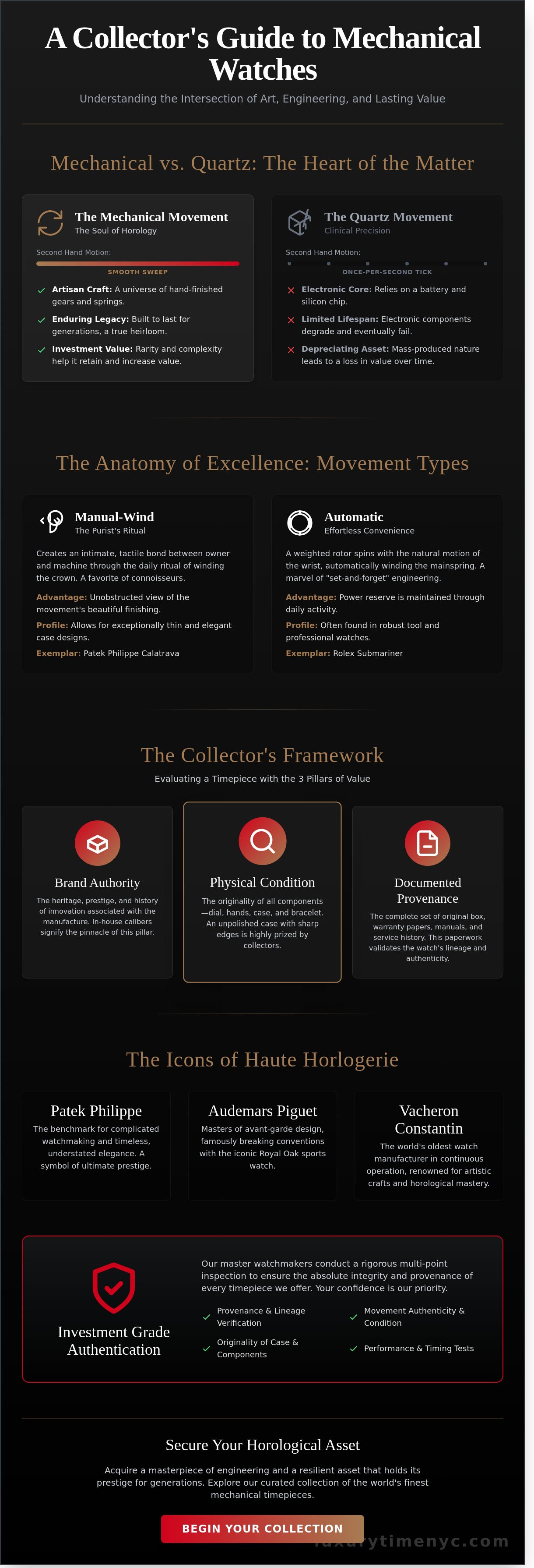
A mechanical watch is a micro-engineered universe. It functions without a battery or a silicon chip, relying instead on a coiled mainspring to store energy. This energy releases through a complex train of gears, regulated by the rhythmic oscillation of a balance wheel. This isn't just a tool for keeping time. It's an analog heartbeat. While quartz watches offer sterile, clinical precision, mechanical watches provide a soul. The faint, rapid ticking is the sound of 100 or more hand-finished components working in perfect unison.
Heritage matters. The lineage of mechanical horology stretches back to 1675 when Christiaan Huygens patented the balance spring. Today, luxury watchmaking preserves this legacy through hand-polished bridges and mirror-finished screws. Every gear and lever is a testament to human ingenuity. This is horological art at its peak. It's a refusal to accept the disposable nature of modern technology. A mechanical movement represents a permanent connection to the history of craftsmanship.
Mechanical vs. Quartz: Why Collectors Choose the Mainspring
Collectors prioritize the sweeping second hand. A quartz movement ticks once per second, a visual reminder of its electronic nature. A high-grade mechanical calibre beats at 28,800 vibrations per hour, creating a smooth, fluid motion across the dial. Longevity is the deciding factor. Electronic components degrade; silicon chips eventually fail. A mechanical movement is built to be repaired, not replaced. With proper care, these assets endure for centuries. Explore our Mechanical vs. Quartz: Which Movement Is Right for You? guide to learn more.
The Distinction of Fine Watchmaking
Haute Horlogerie represents the pinnacle of the craft. It separates mass-produced movements from horological masterpieces. The distinction often lies in the In-House Calibre. When a manufacture like Vacheron Constantin or Audemars Piguet designs and builds its own movement, the watch gains unrivaled prestige. These aren't just accessories. They're engineering feats. In the heart of the NYC Diamond District, we curate these rare movements for the discerning eye. Provenance is everything. Quality is non-negotiable.
- Mainspring Power: Energy stored through manual winding or kinetic motion.
- Artisan Finishing: Anglage, Geneva stripes, and perlage applied by hand.
- Investment Value: Mechanical movements retain value due to their complexity and rarity.
Selecting mechanical watches isn't merely a purchase. It's an acquisition of a timeless asset. The complexity of the movement reflects the sophistication of the wearer. In a world of digital obsolescence, the mechanical watch remains a steadfast symbol of permanence. Unrivaled precision. Timeless design. This is the standard we uphold.
The Anatomy of Excellence: Movement Types and Complications
At the core of every horological masterpiece lies the caliber. It's the engine. It's the soul. High-end mechanical watches represent a centuries-old tradition of micro-engineering where precision meets artistry. These timepieces rely on stored kinetic energy rather than disposable batteries. This energy is held within a coiled mainspring and released through a complex gear train with unrivaled consistency. For the serious collector, the choice of movement is a statement of lifestyle and appreciation for the craft.
Manual vs. Automatic: Choosing Your Daily Driver
The manual-wind movement offers an intimate, tactile ritual. You turn the crown; you feel the tension build as the spring tightens. This daily engagement creates a visceral bond between the owner and the machine. Purists often favor this caliber for its aesthetic advantages. Without a rotor to block the view, the movement's finishing is fully visible through a sapphire caseback. The Patek Philippe Calatrava stands as the pinnacle of this manual elegance. It's slim. It's understated. It's a masterpiece of restraint.
Automatic movements provide a different kind of sophistication. A weighted rotor spins with the natural motion of your wrist, winding the mainspring as you move. It's the standard for the modern professional who values a "set-and-forget" convenience. The Rolex Submariner exemplifies this robustness. It's a tool watch that thrives on activity and maintains its power reserve through your daily routine. If you seek a timepiece that adapts to your pace, explore our curated collection of mechanical watches to find your next asset.
High Complications: From Tourbillons to Perpetual Calendars
A complication is any function on a watch that goes beyond telling the hours and minutes. These features are the benchmarks of a watchmaker's technical prowess. They transform a simple timekeeper into a sophisticated instrument of logic and art.
- The Tourbillon: Patented by Abraham-Louis Breguet in 1801, this mechanism counters the effects of gravity on the escapement. It's a mark of supreme craftsmanship and a visual spectacle.
- The Perpetual Calendar: This is a feat of mechanical logic. It tracks the date, month, and leap year cycles automatically. Most are engineered to remain accurate without adjustment until the year 2100.
- Chronographs and Minute Repeaters: These complications add tactile and auditory depth. A Minute Repeater chimes the time on demand using tiny internal hammers. It's a rare, labor-intensive craft that commands a significant premium in the global market.
The provenance of these complications determines the long-term value of the piece. In the world of New York commerce, these aren't just features; they're signatures of excellence. Every gear and lever is a testament to a heritage that refuses to be hurried. It's luxury defined by time itself.
The Collector’s Framework: How to Evaluate a Mechanical Watch
Acquiring mechanical watches isn't just a hobby. It's a disciplined investment in heritage and engineering. To evaluate a timepiece properly, a collector must look past the dial and examine the triad of Brand, Condition, and Provenance. The industry remains anchored by the "Holy Trinity" of watchmaking: Patek Philippe, Audemars Piguet, and Vacheron Constantin. These three houses have defined horological excellence for centuries. Their movements are the benchmarks by which all other calibers are measured. When curating a collection of mechanical watches, the focus should always remain on quality over quantity.
In the 2026 market, the distinction between "New Old Stock" (NOS) and pre-owned has never been more critical. A NOS piece, preserved in its original factory state without ever being worn, often commands a 30% premium over its used counterparts. Collectors are increasingly discerning. They'll walk away from a deal if the service history is opaque or undocumented. A movement that hasn't seen a professional overhaul in over five years represents a significant hidden cost. Similarly, a watch missing its original box and papers is an incomplete asset. This omission typically results in a 15% to 20% reduction in total resale value.
Material and Craftsmanship: Platinum, Gold, and Beyond
The choice of metal speaks volumes about a collector's intent. Platinum and white gold represent the height of "stealth wealth." They offer a heavy, substantial presence on the wrist while remaining indistinguishable from steel to the untrained eye. Yellow gold remains the quintessential choice for those who appreciate traditional luxury and a classic aesthetic. We're also seeing a surge in high-tech materials. Grade 5 Titanium and Ceramic, popularized by brands like Richard Mille, provide a lightweight, modern alternative to precious metals. Valuation is deeply tied to the finishing of the movement. Look for Anglage, which is the meticulous hand-polished beveling of plates, and Côtes de Genève stripes. These details aren't merely decorative. They're proof of human artistry that machine-made pieces cannot replicate.
Investment Potential and Resale Value
Certain models have transcended their status as tools to become liquid assets. The Rolex Daytona and Patek Philippe Nautilus frequently appreciate well above their original retail prices. This is driven by both artificial and organic scarcity. In New York City, the secondary market is often the only viable route for acquisition, as waitlists at authorized dealers can span five to ten years for high-demand references. This intense localized demand keeps prices resilient even during broader market shifts. For those focusing specifically on the crown, our pillar guide provides an exhaustive analysis: The Essential Guide to Buying a Rolex in NYC: 2026 Collector’s Edition. Authenticity and documented condition remain the only true guards against market volatility.
Standout Icons: A Curated Selection from Luxury Time NYC
Selection is the hallmark of the true collector. At Luxury Time NYC, we don't simply stock inventory; we curate a vault of horological history. Our current gallery of mechanical watches represents the apex of engineering and aesthetic permanence. These pieces aren't just instruments for measuring time. They're liquid assets with a provenance that commands respect in any boardroom or private club from Manhattan to Geneva.
The Patek Philippe Nautilus 5711/1A
The Nautilus 5711/1A is the definitive luxury sports watch. Forged in high-grade stainless steel, its porthole case design by Gérald Genta remains a global status symbol. This model features the self-winding Calibre 26-330 S C, a movement known for its hacking seconds and refined winding system. Since its discontinuation in 2021, the 5711/1A has transcended retail. In the 2026 secondary market, it continues to command a significant premium, often trading at several times its original MSRP. It's a cornerstone for those who value scarcity and iconic design.
The Rolex Cosmograph Daytona 126500LN
The 2026 iteration of the Rolex Daytona remains the most sought-after chronograph in the NYC Diamond District. The 126500LN is powered by the 4131 movement, a masterpiece of efficiency with a 72-hour power reserve. Its key features include:
- Cerachrom Bezel: A virtually scratchproof ceramic tachymeter scale.
- Oystersteel Construction: Exceptional corrosion resistance and a brilliant luster.
- Precision Engineering: The 4131 caliber incorporates the Chronergy escapement for superior reliability.
Collectors prize the Daytona for its historically stable value retention. It is a staple asset that balances technical prowess with unrivaled market liquidity.
The Audemars Piguet Royal Oak 'Jumbo' Extra-Thin
The Royal Oak 'Jumbo' is an ultra-thin mechanical marvel. It pays direct homage to the 1972 original while housing the expertly finished self-winding Calibre 7121. The 'Petite Tapisserie' dial creates a play of light that defines the Royal Oak's visual identity. At 39mm, its proportions are considered perfect by horological purists. The integrated bracelet and octagonal bezel aren't just design choices; they're signatures of elite craftsmanship. You can browse our full range of Audemars Piguet mechanical masterpieces to find a reference that speaks to your personal legacy.
Acquiring a high-tier timepiece requires a partner who understands the gravity of the investment. Our experts provide the security and discretion essential for high-value acquisitions. Secure your next legacy piece by exploring our Mechanical Watches collection today.
The Acquisition Experience: Security, Authenticity, and Care
A five-figure investment in mechanical watches demands absolute certainty. For the elite collector, the risk of a counterfeit or a modified "franken-watch" is a non-starter. At Luxury Time NYC, we eliminate this anxiety through our proprietary Multi-Point Authentication process. Every timepiece passes through the hands of master watchmakers who examine the caliber, the case integrity, and the historical provenance. This isn't a cursory glance; it's a forensic audit of horological history. We verify every serial number and movement component against manufacturer records to ensure your asset is 100% genuine.
The 47th Street Advantage
Digital transactions have their place, but true connoisseurship thrives on personal consultation. Our showroom at Suite 806 in the heart of the New York Diamond District offers a secure, discreet environment for these high-stakes decisions. Here, transparency is our standard. We provide global provenance, sourcing rare pieces from a network that spans Geneva to Tokyo. You aren't just buying a watch. You're securing a verified asset in a face-to-face setting where every question is answered with authority. For those seeking to master the local market, we recommend our specialized resource: Navigating 47th Street: The Connoisseur’s Guide to New York Watches in 2026.
Preserving Your Asset: Maintenance and Repair
A masterpiece requires consistent stewardship. To maintain the precision of high-complication mechanical watches, a full movement overhaul is necessary every 5 to 7 years. Over time, internal synthetic oils dry out. This increases friction and leads to the degradation of delicate gears. A timely service prevents the need for costly part replacements later. Beyond the movement, the physical profile of the watch must be protected. Collectors should understand that professional polishing is an art form that should be used sparingly. Inexpert hands can easily round the sharp bevels of an Audemars Piguet or the crisp lugs of a Patek Philippe. This loss of original lines can significantly diminish the market value of the piece. Our master technicians prioritize the preservation of the watch's original geometry above all else.
Precision. Heritage. Security. Your journey into high-end horology deserves a partner who values your investment as much as you do. Explore our full collection of investment-grade mechanical watches today.
Elevating Your Legacy Through Horological Excellence
A fine timepiece is more than an accessory. It's a silent testament to engineering and heritage. You've navigated the complexities of movement types and the rigorous criteria for evaluating a true horological asset. These mechanical watches represent the pinnacle of human craft. Every gear and spring reflects a century of precision. Understanding the caliber and provenance of a watch is the first step toward building a collection that endures. Unrivaled precision. Timeless design.
Luxury Time NYC provides the security required for such significant acquisitions. Every piece in our inventory undergoes a rigorous multi-point authentication process. Our Certified Master Watchmaker Authentication ensures each movement functions at peak performance. We invite you to experience our collection within our discreet showroom in the NYC Diamond District, a location that's been the center of global luxury since the early 1920s. For those outside the city, we provide insured global overnight shipping to guarantee your investment's safety.
The right watch doesn't just mark the hour. It commands respect. We're ready to help you find the piece that resonates with your personal history. Secure your next horological masterpiece at Luxury Time NYC.
Frequently Asked Questions
Is a mechanical watch more accurate than a quartz watch?
Quartz movements offer superior chronometric precision, but mechanical watches represent the pinnacle of horological artistry. A COSC certified caliber maintains a deviation of -4 to +6 seconds per day. In contrast, standard quartz oscillators typically vary by 15 seconds per month. For the serious collector, the value lies in the 100 or more hand assembled components rather than mere electronic pulses. It's a choice between utility and heritage.
How long does a mechanical watch last before it needs winding?
Most modern timepieces provide a power reserve of 42 to 72 hours on a full wind. High end calibers, such as those found in a Panerai Luminor, often feature an 8 day reserve. If you set your timepiece down on a Friday evening, a 48 hour reserve ensures it remains active through Sunday afternoon. Consistent winding maintains the tension in the mainspring for optimal performance and ensures the movement remains accurate.
Can I wear my mechanical luxury watch every day?
You can absolutely wear your mechanical timepiece daily, provided the model suits your lifestyle. Modern engineering ensures that a Rolex Submariner or an Omega Seamaster can withstand 300 meters of water pressure and daily shocks. These instruments are designed for resilience. Regular wear also keeps the internal lubricants flowing, which prevents the movement from seizing. It's a functional masterpiece for the modern professional who values both style and durability.
What is the difference between a mechanical and an automatic watch?
An automatic watch is a specific type of mechanical movement that winds itself through the natural motion of your wrist. While all automatic timepieces are mechanical, not all mechanical watches are automatic. Manual movements require you to turn the crown by hand to tension the mainspring. An automatic caliber utilizes a weighted rotor that spins with every movement. Both represent centuries of Swiss tradition and technical mastery in the world of horology.
Why are mechanical watches so expensive compared to smartwatches?
Mechanical watches command a premium because they are hand finished works of art designed to last for generations. A smartwatch becomes obsolete in 3 to 5 years due to battery degradation and software shifts. In contrast, a Patek Philippe caliber involves 1,200 hours of labor and precious metals like 18k gold or 950 platinum. You're investing in a permanent asset, not a disposable piece of consumer electronics that requires frequent replacement.
Do mechanical watches hold their value over time?
Select timepieces from prestigious houses like Rolex or Patek Philippe frequently retain or exceed their original retail value. According to the 2023 Knight Frank Wealth Report, luxury watches saw a 147 percent price growth over the past decade. Provenance and rarity drive this appreciation. A well maintained timepiece serves as a liquid asset within a diversified portfolio. It's a tangible legacy that transcends market volatility and offers long term security.
How often should I service my mechanical watch?
You should service your timepiece every 5 to 10 years to ensure peak performance. Manufacturers like Rolex recently extended their recommended intervals to 10 years for newer calibers. During this process, a master watchmaker disassembles the movement, cleans each of the 200 components, and applies fresh synthetic oils. This meticulous maintenance preserves the integrity of the caliber and protects your long term investment from unnecessary wear and tear.
Is it safe to buy a mechanical watch online?
It's safe to acquire a timepiece online when you partner with an established institution that provides a 100 percent authenticity guarantee. LuxuryTimeNYC operates with the transparency and security expected of a New York City firm. Every watch undergoes a 30 point inspection by certified horologists before shipment. Secure, insured transit ensures your asset arrives in pristine condition. Trust is the foundation of every high value digital transaction in the luxury market.


