


In the current horological climate, the retail price of a timepiece is often the least accurate indicator of its true worth. You recognize that true value isn't found on a boutique price tag. It's found in the scarcity of a specific reference and the absolute integrity of its provenance. The modern collector faces unique challenges, from the anxiety of sophisticated "super-clones" to the confusion of fluctuating secondary market premiums. Identifying luxury watches that hold their value requires more than a passing interest; it demands the eye of a seasoned professional.
You deserve a strategy that treats your collection as a serious financial asset rather than a simple accessory. We'll demystify the gap between MSRP and actual resale performance. This guide provides a clear list of investment-grade references from Rolex, Patek Philippe, and Audemars Piguet that continue to dominate the market. You'll discover a framework for evaluating future liquidity and meet a trusted NYC partner dedicated to absolute authenticity. We explore the specific models, from the steel Daytona to the resurgent Cartier Santos, that represent the safest stores of wealth in 2026. Your journey toward a more robust horological portfolio begins here.
Key Takeaways
- Distinguish between a standard luxury accessory and a genuine investment-grade timepiece. Understand how production caps influence secondary market premiums.
- Identify luxury watches that hold their value by analyzing the enduring liquidity of Rolex and Patek Philippe.
- Evaluate the "Billionaire’s Handshake" and the Cartier renaissance. Discover which rare references are currently outperforming retail expectations.
- Protect your investment by mastering the nuances of condition and provenance. Learn why original box and papers are non-negotiable for serious collectors.
- Connect with a premier NYC partner to ensure absolute authenticity. Gain access to professional movement overhaul and pressure testing to maintain your collection’s integrity.
What Defines Luxury Watches That Hold Their Value?
Acquiring a high-end timepiece is a rite of passage for the modern elite. However, a significant distinction exists between a luxury accessory and an investment-grade timepiece. A luxury accessory provides aesthetic pleasure but often depreciates the moment it leaves the boutique. Conversely, an investment-grade asset relies on a complex alchemy of historical significance, mechanical excellence, and market liquidity. These luxury watches that hold their value aren't merely instruments of time. They're portable stores of wealth. Historical data reveals a consistent ten-year growth curve for iconic tool watches, particularly steel professional models, which often outperform traditional equity markets during periods of volatility.
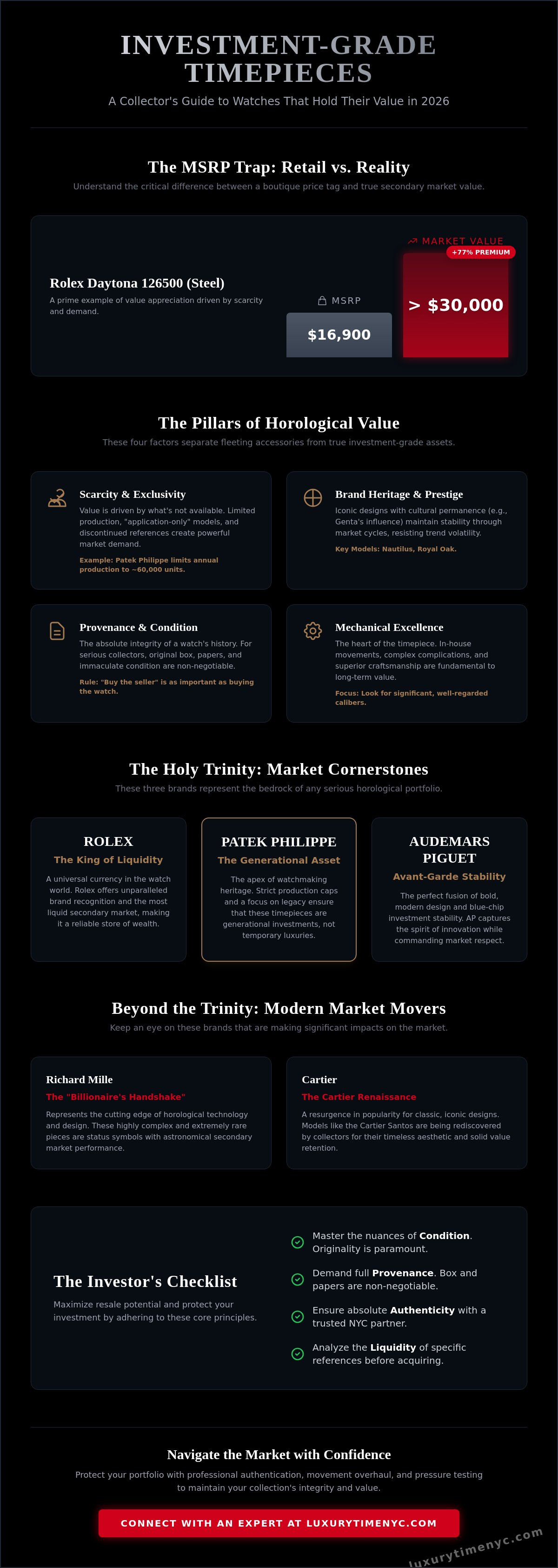
The "MSRP Trap" remains the primary hurdle for novice collectors. In the 2026 landscape, retail price is frequently a fiction. For instance, Rolex increased US retail prices by an average of 4% to 9% in January 2026. While a steel Daytona might retail for $16,900, its secondary market command often exceeds $30,000. This disconnect occurs because value is dictated by the secondary market's willingness to pay a premium for immediate access. This phenomenon is most visible among the most expensive watches ever sold, where provenance and rarity eclipse original list prices by millions of dollars.
Supply and demand dynamics are nowhere more disciplined than at Patek Philippe. By limiting annual production to roughly 60,000 units across all collections, the manufacture ensures that demand perpetually outstrips availability. This intentional scarcity transforms a purchase into a generational acquisition. It's a calculated strategy that maintains the brand's aura of absolute exclusivity.
The Role of Scarcity and Waitlists
Artificial scarcity is the heartbeat of the Rolex professional line. Waitlists are not merely queues; they're barriers to entry that protect the floor of the secondary market. When a reference reaches "discontinued" status, the sudden cessation of supply often triggers an immediate valuation spike. Patek Philippe takes this further with "Application-only" pieces. These references are reserved for collectors with documented loyalty, ensuring that the most significant horological assets remain in the hands of those who value heritage over a quick flip.
Cultural Permanence vs. Trend Volatility
Design language dictates long-term stability. The Genta influence, seen in the Nautilus and Royal Oak, has created a blueprint for value retention that has endured for over five decades. While "hype watches" often crash when social media trends pivot, heritage models remain stable due to their cultural permanence. An investment-grade timepiece represents the precise intersection of extreme mechanical rarity and sustained global demand. By prioritizing iconic silhouettes over fleeting aesthetics, you ensure your collection survives market cycles intact.
The Big Three: Rolex, Patek Philippe, and Audemars Piguet
In the hierarchy of horology, three names command undisputed authority. Rolex, Patek Philippe, and Audemars Piguet represent the bedrock of any serious portfolio. Within the 2026 NYC market, these manufacturers don't just produce timepieces. They issue financial instruments. While many brands attempt to capture the zeitgeist, these firms focus on the fundamental factors that determine a watch's value: heritage, scarcity, and mechanical integrity. These are the luxury watches that hold their value through economic shifts, acting as a hedge against inflation and market volatility.
The 2026 Manhattan secondary market reflects a sophisticated equilibrium. Buyers are no longer chasing every logo. They're targeting specific references with proven liquidity. Rolex remains the apex of liquidity. Patek Philippe defines generational wealth. Audemars Piguet captures the intersection of avant-garde design and blue-chip stability. Understanding the nuances of these "Big Three" is essential for any collector viewing their acquisitions through a fiscal lens.
Rolex: The King of Liquidity
Rolex remains the most liquid asset in the horological world. It's a universal currency. The Stainless Steel Daytona 126500 is a prime example of this dominance. With a retail price of $16,900, it frequently commands $30,000 or more in the secondary market. Similarly, the GMT-Master II 126710GRNR, retailing at $12,000, sees secondary prices exceeding $20,000. The Submariner 124060 remains the "S&P 500" of collecting. Its retail price of $10,050 is consistently eclipsed by secondary valuations above $11,500. For a deeper analysis of local market dynamics, consult The Essential Guide to Buying a Rolex in NYC. These models offer a unique combination of mass recognition and restricted supply that ensures their floor remains high.
Patek Philippe and the Holy Trinity
Patek Philippe occupies a different psychological space. It's an acquisition for the future. The Nautilus 5811/1G in white gold perfectly illustrates the "Nautilus effect." While its retail price sits near $89,767, the secondary market often demands $150,000. This massive premium stems from a five to eight-year waitlist and a production cap of roughly 60,000 watches annually across all collections. Beyond sports models, complications are significant value drivers. Perpetual calendars and chronographs from the manufacture are prized for their technical complexity and historical significance. Our Patek Philippe New York: Acquisition Guide details how to secure these generational pieces. In 2026, the brand's commitment to hand-finishing remains its greatest asset.
Audemars Piguet completes the trio with a focus on design-led value. The Royal Oak remains their flagship of retention. With an annual production of approximately 50,000 units, the manufacture maintains a tight grip on supply. The Royal Oak Chronograph 41mm in steel, retailing at $44,400, currently trades between $55,000 and $58,000. It's a testament to Genta’s enduring design language. If you're looking to diversify your holdings, you might browse our curated selection of Audemars Piguet to find a reference that aligns with your investment goals. Authenticity is never a question; it's a foundation of our service.
Emerging Assets: Richard Mille and the Cartier Renaissance
The 2026 horological landscape has expanded beyond the traditional hegemony of the Big Three. Savvy collectors are diversifying. They're looking toward manufacturers that combine avant-garde engineering with historical elegance. Current 2026 luxury watch market trends indicate a significant surge in demand for smaller, more refined references alongside ultra-exclusive technical marvels. These luxury watches that hold their value represent a shift toward connoisseurship over mere brand recognition.
Richard Mille: Engineering as Value
Richard Mille remains the ultimate "Billionaire’s Handshake." It's a title earned through extreme scarcity and radical innovation. The manufacture produces approximately 5,300 watches annually. This restricted output ensures that demand perpetually exceeds supply. Materials like Carbon TPT and Grade 5 titanium aren't just for show. They're barriers to entry. High-profile athlete endorsements have solidified the brand's cultural equity. An RM 11-03 Flyback Chronograph currently commands approximately $198,000 in the secondary market. The RM 055 "Bubba Watson" remains a titan, trading between $440,000 and $500,000. Rarity is the guarantee here.
Cartier’s Return to the Investment Conversation
Cartier has shed its fashion brand label to become a collector's darling. The "Cartier Renaissance" is driven by a renewed appreciation for shape and heritage. Limited edition Tank and Santos models are currently outperforming many traditional sports watches. The Collection Privée Cartier Paris (CPCP) remains a focal point for serious acquisition. Specifically, the "Paris" dial signature has become a non-negotiable marker of value for the elite. Popular Cartier models now retain between 87% and 99% of their retail value. May 2026 saw price increases of up to 7%, further bolstering the floor for existing owners. The Santos-Dumont Ref. WSSA0032 now retails at $7,800, reflecting this upward trajectory.
Vacheron Constantin’s Overseas collection serves as the dark horse of the 2026 market. It offers a sophisticated alternative to the more ubiquitous sports models. Beyond the current catalog, "Neo-Vintage" sleepers from the late 1990s and early 2000s are beginning to stir. These references offer a unique entry point before they hit peak market saturation. Identifying these assets requires a deep understanding of movement architecture and production history. It's about finding tomorrow's icons today.
The Investor’s Checklist: Maximizing Resale Potential
Acquiring a blue-chip reference is merely the first step. To ensure your luxury watches that hold their value remain robust financial assets, you must pivot from collector to curator. In the 2026 secondary market, the difference between a record-breaking sale and a stagnant listing often comes down to the minute details of the investor's checklist. Condition, provenance, and mechanical integrity are the three pillars that support long-term appreciation. Neglecting these factors can turn a premier asset into a liability.
Condition remains the absolute arbiter of value. While a pristine appearance is desirable, over-polishing is a cardinal sin for vintage and neo-vintage pieces. Removing metal to erase scratches often destroys the original factory chamfers and case geometry. This inadvertently devalues the timepiece in the eyes of sophisticated buyers who prize unpolished examples. If maintenance is required, it should be handled by an elite facility that understands the nuances of preservation. You can find detailed strategies for this in The Connoisseur’s Guide to Luxury Watch Repair in NYC.
Condition Grading for Collectors
Collectors seek sharp, defined edges and original finishes. A case that has retained its original proportions commands a significant premium. Similarly, the dial's state is paramount. Natural aging, such as the tropical effect on certain Submariner or Speedmaster dials, can exponentially increase valuation. However, any sign of moisture ingress or aftermarket parts will immediately compromise the asset's liquidity. Pristine dials. Original hands. Sharp lugs. These are the hallmarks of a grade-A investment.
Provenance and Documentation
The "Full Set" status is non-negotiable for top-tier retention. This includes the original box, warranty papers, hangtags, and even the original sales receipt. These documents establish a clean history and provide a layer of security in an era of sophisticated counterfeits. In 2026, a watch without papers is a watch with a 15-25% haircut in value. This documentation serves as the watch's birth certificate. Without it, the provenance is broken and the pool of potential buyers shrinks significantly.
Mechanical integrity is equally vital. A documented service history from a reputable NYC facility acts as an insurance policy for the next owner. Professional movement overhaul and pressure testing ensure the timepiece operates within chronometric specifications. Authentication is the final, most critical step. With the rise of super-clones, a definitive watch authentication from a trusted institution is the only way to safeguard your capital. Protecting your investment requires a commitment to excellence that matches the craftsmanship of the watch itself.
Navigating the 2026 Market with Luxury Time NYC
The New York City Diamond District is more than a geographic location. It's the beating heart of the global secondary market. In this high-stakes environment, identifying luxury watches that hold their value requires a partner with deep roots in the district’s trading volume. Luxury Time NYC stands at the center of this commerce. We offer an aura of security that's essential when dealing with high-value assets. Our institution serves as a guardian of authenticity, ensuring that every timepiece in your collection is a verified masterpiece. This isn't a marketing claim. It's a definitive fact of our operation.
We recognize that for the elite collector, time is the ultimate luxury. Our private consultations are designed to be deliberate and spacious. We don't rush the process. Instead, we invite you to linger over technical details and historical provenance. Whether you're looking to acquire a Rolex, Patek Philippe, or Richard Mille, we provide the expertise to ensure your capital is deployed effectively. Our buy-back and trade-in programs offer the immediate liquidity necessary to maintain a fluid portfolio. This flexibility allows you to pivot your holdings as market conditions evolve.
The Advantage of a Manhattan Showroom
Digital images can't replace the tactile experience of horology. Physical inspection is the only way to truly verify "Investment Grade" condition. In our showroom, you can witness the play of light on a perfectly preserved case or examine the intricate complications of a Patek Philippe. We provide real-time market pricing based on the daily volume of the Diamond District. This ensures your acquisition reflects the most current global valuations. For those seeking to master the local landscape, Navigating 47th Street: The Connoisseur’s Guide provides the necessary context for successful trading.
Your Partner in Horological Wealth
Exclusivity is our standard. We specialize in sourcing rare, off-market references that remain hidden from the general public. Our network, established in 2005, provides access to the world’s most sought-after movements. We operate with the discretion and professionalism expected by serious collectors. We aren't just a boutique; we're a metropolitan institution dedicated to the preservation of fine mechanical arts. From professional movement overhaul to precise watch authentication, we protect the integrity of your assets. Explore our curated collection of investment-grade timepieces at Luxury Time NYC.
Preserving Wealth Through Horological Excellence
The 2026 market rewards the disciplined collector. You've seen how true value transcends retail pricing. It's found in the intersection of mechanical rarity and documented provenance. By focusing on blue-chip references and maintaining a "Full Set" standard, you ensure your luxury watches that hold their value remain liquid assets. Scarcity remains the ultimate arbiter. Heritage is the final word. Every acquisition should be a calculated step toward a more robust financial portfolio.
Located in the heart of NYC's Diamond District, Luxury Time NYC serves as your professional gateway to the global luxury market. We provide a certified authenticity guarantee that's absolute. Our experts specialize in sourcing rare references that define the pinnacle of fine engineering. Whether you're seeking a specific Nautilus or a technical Richard Mille, our sourcing capabilities are unmatched. We treat your search with the discretion it deserves. Our metropolitan institution is built on a foundation of deep industry knowledge and exclusive access.
Secure your next investment-grade timepiece at Luxury Time NYC. Your collection is more than a hobby; it's a legacy. Curate it with the quiet confidence of a true connoisseur.
Frequently Asked Questions
Which watch brand holds its value best for beginners?
Rolex is the premier choice for those beginning a collection. Its universal recognition and consistent global demand make it the most liquid asset in horology. Steel professional models, such as the Submariner, provide a stable financial floor. These are the primary luxury watches that hold their value through various market cycles and economic shifts.
Is it better to buy a new or pre-owned watch for investment?
In the 2026 market, the distinction between new and pre-owned is often eclipsed by immediate availability. For many investment-grade references, the secondary market is the only viable acquisition path. Buying pre-owned from a trusted NYC partner ensures you bypass years-long waitlists. This approach allows you to secure assets that are already trading significantly above their original retail figures.
How much does a missing box and papers affect a watch's value?
A missing box and papers typically results in a 15% to 25% reduction in market value. This "Full Set" documentation acts as the watch's birth certificate and absolute proof of provenance. For serious collectors, these items are non-negotiable. An incomplete set suggests a break in the watch’s history. It complicates future liquidity and devalues the asset in the eyes of elite buyers.
Do gold watches hold their value better than stainless steel?
Stainless steel professional models generally outperform precious metal references in percentage of value retention. While gold has intrinsic material worth, the rarity and cultural demand for steel sports watches drive higher secondary premiums. Rolex and Patek Philippe steel references remain the primary targets for growth-oriented portfolios. Gold references are often viewed as more conservative, long-term stores of wealth.
What is the 'Rolex bubble' and has it burst in 2026?
The "Rolex bubble" refers to the speculative price surge seen in 2022. By 2026, the market has transitioned into a period of organic, stable growth. Prices for key references like the GMT-Master II and Daytona remain significantly above retail. The speculative frenzy has been replaced by a more deliberate and sustainable demand. This stability reinforces the brand's position as a robust financial asset.
Can I wear my investment watch, or will it lose value?
You can wear your timepiece, but condition remains the arbiter of resale price. Light wear is expected for many references. However, significant damage to the case or crystal will necessitate professional intervention. Maintaining the original factory finish is essential for those viewing luxury watches that hold their value as strictly financial instruments. Deep gouges or over-polishing will negatively impact your final return.
How often should I service my watch to maintain its resale price?
We recommend a professional movement overhaul and pressure testing every five to seven years. Documented service history from an established institution adds a layer of security for the next owner. It proves the mechanical integrity of the movement and ensures the watch is water-resistant. Consistent maintenance prevents long-term wear and ensures the timepiece operates within its original chronometric specifications.
Why are some watches worth more pre-owned than their original retail price?
Secondary market premiums are driven by the chasm between production caps and global demand. When a manufacturer like Patek Philippe limits output to 60,000 units, waitlists can extend beyond five years. Collectors are willing to pay a premium to bypass these queues. This scarcity transforms a mechanical tool into a highly sought-after financial asset. Demand in the Diamond District remains the primary driver of these premiums.


