


Why does a factory-set bezel increase a timepiece's long-term hold value by 30% while an aftermarket customization often reduces its liquid worth to the price of its metal and stones? In the world of high horology, the margin between a sound investment and a costly error is measured in microns. You recognize that diamond watches should represent the pinnacle of both artistry and asset preservation. Yet, the anxiety of overpaying for inferior stones or questionable provenance remains a valid concern for the serious collector. It's a delicate balance between aesthetic brilliance and financial wisdom.
This guide provides the clarity required to identify these complexities with the confidence of a seasoned connoisseur. You'll master the nuances of gem-setting techniques and understand how specific configurations impact future resale. We'll explore the technical mastery behind these mechanical wonders and outline the essential steps for sourcing a prestigious timepiece through a trusted New York City partner. From the precision of the caliber to the clarity of the setting, we invite you to discover how to select a wearable masterpiece that commands respect in any room.
Key Takeaways
- Distinguish between factory and aftermarket settings to ensure your acquisition maintains its long-term investment value and prestige.
- Master the specific 4Cs of horology to evaluate the clarity and cut of diamond watches with the precision of a seasoned collector.
- Discover how legendary houses like Rolex and Patek Philippe utilize exquisite gem-setting to transform iconic tool watches into horological masterpieces.
- Learn to select the optimal precious metal base, from platinum to 18k white gold, to enhance the fire and brilliance of each hand-set stone.
- Gain the insider knowledge required to navigate the NYC Diamond District and source authenticated, provenance-backed timepieces with absolute confidence.
Understanding Diamond Watches: Factory vs. Aftermarket Settings
A diamond watch represents the ultimate synthesis of haute horlogerie and high jewelry. It isn't merely a timepiece; it's a masterpiece of engineering adorned with Earth's most resilient treasures. For the elite collector, diamond watches serve as both a personal statement and a portable asset. The distinction between a factory-set piece and an aftermarket customization is the most critical factor in determining a watch's future legacy. This choice defines the boundary between a standard luxury accessory and a true horological investment.
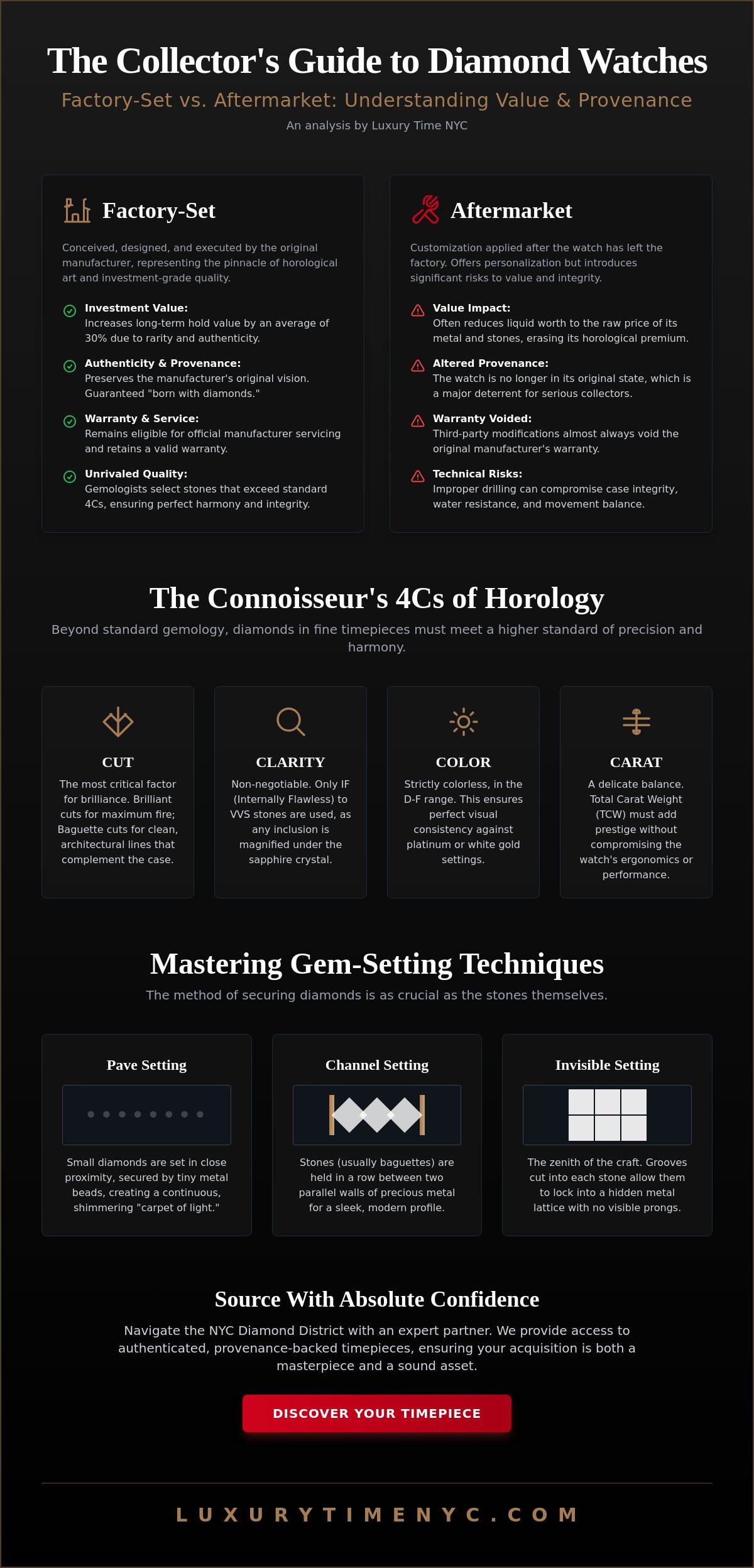
Factory-set watches are conceived, designed, and executed within the walls of the manufacture. Brands like Rolex and Patek Philippe employ dedicated gemologists to ensure every stone meets an internal standard that often surpasses The Connoisseur’s 4Cs. Every diamond is calibrated for height, orientation, and color consistency. This level of precision ensures that the jewelry never compromises the mechanical integrity of the caliber. It's a harmonious balance. Unrivaled craftsmanship meets absolute technical perfection.
The Value Retention of Factory Diamond Watches
Collectors prioritize factory-set models because they preserve the original provenance of the timepiece. A "born with diamonds" watch from Audemars Piguet or Patek Philippe remains eligible for official servicing and carries a valid manufacturer warranty. These pieces are produced in limited quantities, often reserved for a brand's most loyal clientele. This scarcity drives demand in the secondary market. Investors frequently pay a significant premium for factory settings because they represent the manufacturer’s original vision. Authenticity is absolute. Value is enduring.
Aftermarket Customization: What You Need to Know
The "Iced Out" aesthetic has gained immense popularity in modern luxury culture, allowing for a level of personal expression that factory models can't always match. These custom pieces involve adding diamonds to a standard steel or gold model after it leaves the factory. While the visual impact is undeniable, the technical risks are real. Custom drilling can compromise the case's water resistance or affect the movement's balance.
Luxury Time NYC views aftermarket work through a lens of transparency and technical scrutiny. We evaluate custom pieces based on the quality of the stone setting and the preservation of the original architecture. It's vital to understand that an aftermarket bezel or dial typically voids the original manufacturer warranty. For those seeking personal flair, customization offers a unique path. For those seeking investment stability, the factory set remains the gold standard. Knowledge is the ultimate luxury. Choose with confidence.
The Connoisseur’s 4Cs: Evaluating Diamonds in Fine Horology
In high horology, the traditional 4Cs take on a more rigorous dimension. When you evaluate diamond watches, the standards of the Gemological Institute of America (GIA) are merely the starting point. The stones must harmonize with the mechanical soul of the timepiece. As discussed in Forbes regarding Investment, Artistry, and Provenance, the aesthetic appeal often dictates long-term desirability as much as the movement itself. Precision is the only metric that matters.
Cut remains the most critical factor for light return. Brilliant cuts offer 58 facets of fire, while Baguette cuts provide a clean, architectural geometry that complements a watch's case lines. Clarity is non-negotiable. We demand IF to VVS stones. In the confined space of a dial, even a microscopic inclusion is magnified by the sapphire crystal. Color must be strictly colorless, typically within the D to F range. This ensures the bezel doesn't clash with the white gold or platinum housing. Carat weight is a delicate balance. A high Total Carat Weight (TCW) adds prestige, but it shouldn't compromise the watch's ergonomics or the caliber's performance. Weight must be distributed with intent.
Mastering the Setting Techniques
Pave settings involve placing small diamonds in close proximity, secured by tiny beads of precious metal. It creates a shimmering carpet of light across the watch face. Channel settings utilize two parallel walls of gold to hold a row of stones, usually baguettes. This technique offers a sleek, modern profile for the bezel. The invisible setting represents the zenith of the craft. Grooves are cut into the base of each stone, allowing them to snap into a hidden lattice. It's a high-risk endeavor found only in the most complex pieces from houses like Cartier or Patek Philippe.
The Importance of Stone Matching
Mastery is found in the details. Every stone must possess identical height and hue. If one diamond sits a fraction of a millimeter higher than its neighbor, the symmetry of the piece is ruined. The master setter works in tandem with the case maker to ensure the drilling of stone seats doesn't compromise the structural integrity or water resistance. Horological gem-setting is the disciplined marriage of metallurgical precision and lapidary art where the stone must serve the instrument's function. For those seeking such precision, exploring a curated collection of diamond watches reveals the true height of this specialized craft.
Iconic Diamond Watches: Comparing Rolex, Patek, and AP
The intersection of high horology and fine jewelry creates a category of diamond watches that transcend mere timekeeping. These pieces represent a curated fusion of Swiss precision and geological rarity. Cartier led this movement early on, blending French aesthetic heritage with mechanical rigor in the Tank and Santos collections. Today, the landscape is dominated by a "Big Three" that define how stones are integrated into steel and gold. These aren't just accessories. They're enduring assets. Every setting reflects a legacy of craftsmanship and a commitment to unrivaled excellence.
Rolex Diamond Configurations: From Subtle to Statement
Rolex mastery lies in the factory setting. Every stone is hand-selected. The Day-Date, famously known as the "President," remains the gold standard for executive elegance. Collectors often seek the "Serti" dial, a vintage hallmark found in the Submariner and GMT-Master II lines that utilizes rubies, sapphires, and diamonds as hour markers. While a Datejust with a diamond bezel offers daily versatility, the Pearlmaster represents a dedicated foray into high jewelry with fully paved bracelets and cases. Selecting the right configuration requires local expertise. For those navigating the secondary market, The Essential Guide to Buying a Rolex in NYC offers critical insights into sourcing authentic, factory-set pieces. The brand’s commitment to brilliance is mirrored in their adherence to the GIA's 4Cs of Diamond Quality, ensuring every stone meets internal standards for clarity and color.
Patek Philippe & AP: The Pinnacle of Gem-Set Sport Watches
The Patek Philippe Nautilus changed the perception of the sports watch. In its diamond-set iterations, it becomes a formal masterpiece. The reference 5719/1G is a study in excess, featuring a white gold build entirely covered in 1,343 diamonds. It's rare. It's unrivaled. Similarly, Audemars Piguet has redefined the Royal Oak through texture and light. The "Frosted Gold" finish, debuted in 2016 in collaboration with Carolina Bucci, uses a hammered technique to create a diamond-like shimmer without a single stone. For those demanding literal brilliance, the Royal Oak Offshore provides a larger canvas for bold settings and intricate pave work.
- Patek Philippe 5719/1G: Features a full-pave dial and integrated bracelet with over 1,300 stones.
- AP Royal Oak: Available in "Rainbow" bezel configurations using 32 baguette-cut sapphires to create a spectrum effect.
- Cartier Santos: A bridge between 1904 aviation history and modern jewelry artistry.
Investing in diamond watches from these houses requires an appreciation for both the caliber inside and the provenance of the gems outside. Whether it's the quiet confidence of a diamond-marker Rolex or the loud prestige of a paved Patek, these timepieces command respect in any room. They represent the pinnacle of the world’s finest mechanical arts, maintained by the hands of master gem-setters and horologists alike.
A Framework for Selecting Your Diamond Timepiece
Selecting the right diamond watch requires a balance of aesthetic desire and technical scrutiny. The process begins with the intended environment. A timepiece for daily wear demands a different approach than a piece reserved for high-profile events. For the office or a private club, subtle diamond dial markers on a Rolex Datejust offer refined brilliance. For the red carpet, a fully iced Audemars Piguet Royal Oak defines the moment. Purpose dictates the level of "ice" that is appropriate.
Matching Metal to Stone Brilliance
The choice of metal acts as the foundation for every gem. 18k White Gold and Platinum are the industry standards for a reason. These metals provide a neutral canvas that allows colorless diamonds to achieve their maximum fire without yellow tinting. Platinum, specifically, offers a weight and density that signifies "stealth luxury." It's a choice for the connoisseur who values substance. Conversely, yellow and rose gold create a high-contrast backdrop. This warmth emphasizes the brilliance of the stones through stark juxtaposition. When you're buying and selling watches with gem settings, the metal choice significantly impacts secondary market liquidity and long-term value retention.
Diamond placement dictates the character of the piece. Consider these three common configurations:
- Dial Markers: Subdued, professional elegance.
- The Bezel: The classic horological statement.
- Full Case and Bracelet: Total immersion in luxury.
Size and proportion are equally critical. A 41mm case adorned with stones often presents a larger visual footprint than a steel equivalent. The light refraction from the diamonds creates an optical expansion. Ensure the gems complement the wrist without overwhelming your physical proportions. It's about presence, not just volume.
Avoiding Common Mistakes in Diamond Watch Acquisition
The "Value Trap" remains the most frequent error for new collectors. This involves overpaying for aftermarket diamond setting. While these pieces look impressive, they lack the precision of factory work and often void manufacturer warranties. They rarely hold their value during a resale. Always prioritize factory-set pieces to ensure the integrity of the watch. The movement must remain a priority. A diamond watch is still a precision instrument. Its caliber should be as exquisite as its exterior. Always check for original factory papers when buying pre-owned to verify that both the movement and the stones are authentic to the manufacturer.
Provenance is the final pillar of a secure investment. Verify the history of the watch through archived records and certified appraisals. In the New York market, authenticity isn't just a preference; it's a requirement for any serious asset.
Sourcing Diamond Watches in the NYC Diamond District
New York City’s 47th Street is the undisputed center of the global jewelry trade. It’s a place where history meets high-stakes commerce. Luxury Time NYC stands at the heart of this district, offering an experience that transcends the typical retail encounter. We provide a sanctuary for collectors seeking diamond watches that embody both technical mastery and aesthetic brilliance. Our position on 47th Street grants us immediate access to the finest stones and the most elusive timepieces in the world. This is where provenance is verified and legacies are built.
The distinction between factory-set and custom-set pieces is a critical consideration for any serious investor. Factory pieces represent the manufacturer’s original vision, with gems selected and set by the brand’s own master jewelers. Custom pieces offer a path to personal expression, provided the craftsmanship meets our exacting standards. We curate both with extreme prejudice, ensuring every stone’s cut, color, and clarity align with the watch’s horological heritage. An in-person inspection is essential. It’s the only way to appreciate how light interacts with the dial or how the bracelet contours to the wrist. Our consultants don't just sell; they educate. They provide the technical data required for an informed acquisition.
The Luxury Time NYC Guarantee
Authenticity is our foundation. Every gem-set timepiece undergoes a rigorous 10-point authentication process. We examine the movement’s caliber, the setting’s integrity, and the stones’ provenance. There’s no room for ambiguity. Our global sourcing network allows us to secure rare, off-market models that never reach a public display case. We act as your eyes in a complex market. For those planning a visit to our showroom, our guide on Navigating 47th Street offers essential insights into the district's unique dynamics.
Maintaining the Brilliance
A diamond-set watch is a delicate mechanical ecosystem. Over time, prongs can shift and stones can lose their luster due to microscopic debris. Regular maintenance is a necessity, not an option. Our specialized cleaning and prong inspection services preserve the structural integrity of your timepiece. You shouldn't trust these assets to a generalist. Only NYC watch repair experts with specific experience in gem-setting can guarantee the safety of your investment. We ensure your watch remains as radiant as the day it was crafted. Timeless design. Unrivaled precision.
Discover the intersection of horology and fine jewelry. Browse our exclusive Diamond Watch collection and find a masterpiece that resonates with your personal legacy.
Secure Your Horological Legacy
Acquiring a masterpiece is a commitment to enduring value. Mastery of the distinction between factory and aftermarket settings remains the primary pillar of provenance for diamond watches. Whether you're evaluating the stone clarity in a Rolex or the setting precision of an Audemars Piguet, the horological 4Cs define the asset's future. Since 2005, LuxuryTimeNYC has served the global elite from the heart of the New York City Diamond District. We provide a definitive environment for collectors who demand absolute security. Every timepiece in our vault carries a certified authenticity guarantee. It's a standard that ensures your investment is as genuine as the heritage it represents. We specialize in the curation of Rolex, Patek Philippe, and Audemars Piguet; our expertise transforms a complex acquisition into a seamless, prestigious experience. The right timepiece doesn't just mark time. It defines it. We invite you to begin your next chapter with a partner who understands the gravity of your collection.
Explore our curated collection of investment-grade Diamond Watches
Frequently Asked Questions
Do diamond watches hold their value as well as steel models?
Factory-set diamond watches typically retain higher resale value than aftermarket modifications, though stainless steel sports models often command higher premiums on the secondary market. A 2023 industry report indicates that professional steel models can appreciate by 20% to 50% above retail, while gem-set pieces often stabilize near their original MSRP. The value lies in the rarity of the stones and the prestige of the factory setting. It's a balance of artistry and market demand.
What is the difference between factory set and aftermarket diamonds?
Factory-set diamonds are selected and mounted by the manufacturer’s own gemologists to ensure perfect alignment and stone quality. Aftermarket diamonds are added by third-party jewelers after the watch leaves the manufacture. This distinction is critical for collectors. A factory-set Patek Philippe maintains its original warranty and provenance, whereas aftermarket modifications can reduce a timepiece's value by 30% or more at auction. Authenticity is paramount in high-stakes horology.
Can I add diamonds to my Rolex or Patek Philippe later?
You can technically add diamonds to any timepiece through a jeweler, but doing so often voids the manufacturer's warranty and complicates future servicing. Rolex and Patek Philippe service centers frequently refuse to work on modified watches. For the serious collector, altering the original state of a masterpiece is a risk. It's better to acquire a factory-set model to preserve the integrity of the caliber and the brand's official provenance. Originality defines true luxury.
Are lab-grown diamonds used in luxury watches?
The "Big Three" watchmakers, Patek Philippe, Audemars Piguet, and Vacheron Constantin, exclusively use natural, ethically sourced diamonds in their collections. These stones must meet rigorous Top Wesselton standards for clarity and color. While lab-grown diamonds exist in the broader jewelry market, they haven't yet breached the catalogs of heritage horology houses. Natural stones remains the standard for diamond watches intended as long-term assets. Exclusivity requires the rarest materials earth provides.
How do I clean a diamond watch without damaging the movement?
Clean your watch using a soft-bristled brush and lukewarm, soapy water while ensuring the crown is fully screwed down. This prevents moisture from entering the delicate movement. Avoid ultrasonic cleaners, as the high-frequency vibrations can loosen the diamond settings or disrupt the escapement. For a timepiece with a depth rating of 100 meters, a gentle rinse is sufficient. Use a lint-free microfiber cloth for the final polish. Proper maintenance preserves brilliance and precision.
Is it safe to buy a diamond watch online?
Buying a diamond watch online is secure when you partner with a trusted New York City institution that provides physical authentication. Look for sellers who offer a 100% authenticity guarantee and detailed condition reports. Reputable dealers will provide high-resolution photography of the specific serial numbers and hallmarks. Secure, insured shipping ensures your investment arrives safely. Trust is the currency of the global luxury market. We treat every transaction with absolute discretion.
What are baguette diamonds and why are they more expensive?
Baguette diamonds are thin, rectangular stones featuring a step-cut facet pattern that emphasizes clarity over brilliance. They're more expensive because the cut requires a higher grade of raw stone; inclusions are much more visible in a step-cut than in a traditional round brilliant. In a Rolex Day-Date, the precision required to align these stones perfectly across the bezel demands exceptional horological craftsmanship. Only the top 5% of gem-quality diamonds typically qualify for this cut.
How much does a diamond bezel affect the price of a Rolex?
A factory diamond bezel typically adds between $5,000 and $15,000 to the retail price of a Rolex Datejust or Day-Date. This premium reflects the cost of the stones and the labor involved in the setting process. According to official 2024 price lists, the gap between a fluted bezel and a gem-set bezel is a definitive marker of the watch's status. It transforms a standard luxury tool into a piece of fine jewelry. Excellence has a clear, measurable cost.


