


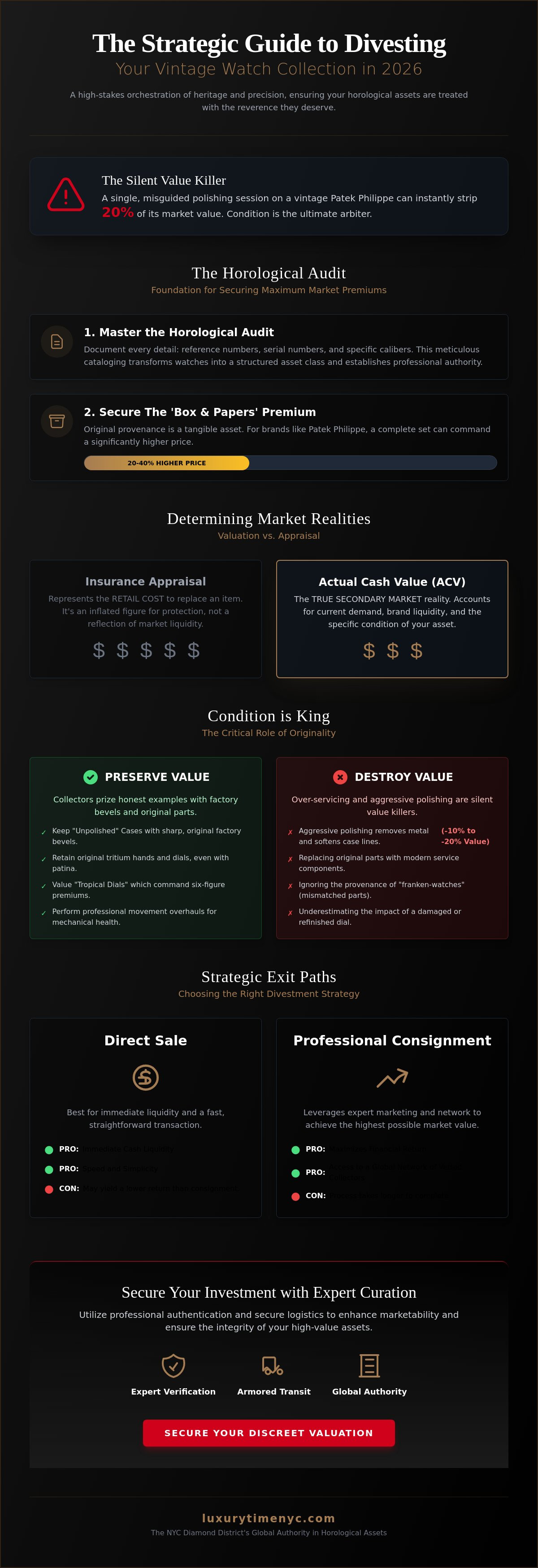
A single, misguided polishing session can instantly strip 20% of the value from a vintage Patek Philippe. For the serious collector, divestment isn't merely a transaction. It's a high-stakes orchestration of heritage and precision. You've spent years curating a portfolio of horological icons, yet the path to liquidation is often clouded by predatory valuations and logistical risks. Knowing how to sell a vintage watch collection requires more than a simple marketplace. It demands a strategic roadmap that respects the provenance of every reference.
You recognize that these pieces are enduring assets, not just accessories. It's natural to feel protective over the integrity of original parts or the security of high-value transit. This guide provides the definitive framework for navigating the 2026 market. You'll learn how to secure a discreet valuation and a transparent exit strategy that maximizes your return. We'll examine the critical role of professional authentication, the impact of the current 15% Swiss import tariff, and the precise steps to ensure your collection is treated with the reverence it deserves.
Key Takeaways
- Master the art of the horological audit by documenting reference numbers and original components to secure maximum market premiums.
- Distinguish between insurance appraisals and actual cash value, prioritizing unpolished cases to preserve the historical integrity of your pieces.
- Evaluate strategic exit paths, including direct sale for immediate liquidity or professional consignment, to understand exactly how to sell a vintage watch collection with precision.
- Secure your investment through armored transit and expert verification within the global authority of the NYC Diamond District.
- Utilize professional movement overhauls and authentication to enhance the marketability and provenance of high-value assets from Patek Philippe and Rolex.
The Horological Audit: Cataloging Your Vintage Collection for Sale
A successful divestment begins with a rigorous audit. It's the foundation of professional authority. Understanding how to sell a vintage watch collection requires a transition from collector to curator. You must document every technical nuance to ensure no value is left on the table. A comprehensive inventory serves as your strategic roadmap; it should detail reference numbers, serial numbers, and specific caliber information for every piece in the portfolio. This meticulous cataloging transforms a group of watches into a structured asset class.
Distinguishing your "star pieces" from the supporting cast is essential for a high-impact exit. High-value icons, such as a Patek Philippe Reference 4700/160J or a rare Rolex Datejust, require individual focus. These investment-grade assets command a different level of scrutiny than the rest of the collection. High-resolution macro photography is the final step of the audit. These images establish a definitive condition report, capturing the delicate patina of a dial or the sharp edges of an unpolished case before the appraisal process begins. Detailed imagery provides the transparency that high-net-worth buyers expect.
Identifying Reference Numbers and Calibers
Precision is paramount. On a vintage Rolex, the reference number is typically engraved between the lugs at the 12 o'clock position, while the serial number resides at 6 o'clock. Patek Philippe often places these identifiers inside the caseback or directly on the movement bridges. A reference number serves as the primary identifier for market valuation. Matching these numbers to specific production years is vital for verifying authenticity. It confirms that the caliber, dial, and case are period-correct. This level of technical detail builds the quiet confidence that elite buyers demand.
The 'Box and Papers' Premium
Provenance is a tangible asset. For a Patek Philippe, the presence of the original box and punched papers can command a 20-40% higher price than a "naked" watch. These components are more than ephemera; they are historical proof of a watch's journey. Documentation should be stored in acid-free environments, separate from the timepieces, to prevent moisture damage or ink fading. Recent service records are equally critical. Data from May 2026 suggests that a professional movement overhaul within the last 18 months significantly increases a watch's perceived value. Utilizing a reputable specialist such as Atoz Watch And Jewellery Repairs ensures that these mechanical interventions are performed and documented with the precision required for the secondary market. It removes the buyer's anxiety regarding immediate maintenance costs and reinforces the integrity of the collection.
Valuation vs. Appraisal: Determining Market Realities
An insurance appraisal is a safeguard. It represents the cost to replace an item at retail. Actual Cash Value (ACV) is the reality of the secondary market. When learning how to sell a vintage watch collection, you must focus on the latter. ACV accounts for current demand, brand liquidity, and the specific condition of your assets. In May 2026, the market favors quality over sheer volume. This shift means that a single, exceptional reference often outperforms a dozen mediocre pieces.
Condition remains the ultimate arbiter of value. For vintage steel sports watches, "unpolished" is the most lucrative designation. A sharp, original case with its factory bevels intact is a rarity. Collectors prize these honest examples. Conversely, a watch that has been aggressively polished to look new can suffer a 10-20% reduction in market value. Authentic wear tells a story. It confirms that the metal hasn't been compromised by a buffing wheel. A professional watch authentication can verify these nuances before you commit to a sale.
Provenance extends to the dial. Tropical dials, where UV exposure has shifted black paint to a rich chocolate brown, trigger six-figure premiums. These unique aging patterns can't be replicated. They are organic signatures of history. To understand these technical nuances, many owners review The Connoisseur’s Guide to Buy and Sell Watches to align their expectations with 2026 auction results.
The Crucial Role of Condition and Originality
Over-servicing is a silent value killer. While a movement overhaul is necessary for mechanical health, replacing original tritium hands or dials with modern luminova parts destroys historical value. Serious collectors seek period-correct components. A "franken-watch", one assembled from disparate, non-matching parts, is a liability in a high-end portfolio. Authenticity is absolute. Natural patina on tritium markers should be preserved, not scrubbed away. The market rewards the untouched.
Market Trends and Brand Liquidity
Rolex and Patek Philippe remain the pillars of the secondary market. Rolex implemented an average 7% price increase in early 2026, further solidifying the value of vintage steel models. Meanwhile, neo-vintage Cartier is seeing a surge in demand, particularly for rare Tank and Santos variations. Independent manufacturers are also gaining ground among the elite. Private treaty sales often provide better results for these niche icons than public auctions. Timing your exit requires a deep understanding of these shifting preferences.
Exit Strategies: Consignment, Direct Sale, or Auction?
Choosing the right exit channel is the most consequential decision in the divestment process. It dictates both the final return and the speed of capital recovery. When considering how to sell a vintage watch collection, you must weigh the immediate certainty of a direct sale against the speculative potential of the auction block. Each path offers distinct advantages tailored to specific portfolio goals. A refined strategy treats every reference as an individual asset, ensuring that the method of sale matches the rarity of the piece.
Direct sales provide unmatched liquidity. For the collector seeking an efficient, private transaction, this is the gold standard. A professional institution in a global commerce center can facilitate funding within 24 to 48 hours. This path eliminates the 72-hour buyer return window common in premier watch houses and avoids the 30% fees typical of major auction houses. It's a clean break. You receive a guaranteed payment for the entire collection, bypassing the uncertainty of individual lot performance. This method is particularly effective for high-liquidity steel sports models from Rolex and Patek Philippe.
Consignment remains a powerful tool for trophy assets. It allows for global marketing and expert positioning. While commissions for vintage pieces typically range from 10% to 30%, high-value assets above $50,000 often benefit from lower, negotiated rates. Some specialist consignors offer a flat 10% commission for watches of this caliber. A hybrid strategy is often the most sophisticated choice. Sell core assets directly to secure baseline capital, then consign the rarest references to capture the highest possible market premium. This approach balances immediate financial needs with the patience required for record-breaking results.
Comparing Liquidity Timelines
Time is a luxury in the secondary market. Direct sales in the NYC Diamond District offer the fastest turnaround, often concluding in two business days. Consignment requires a 30 to 90 day window for optimal price realization, as it depends on finding the right private buyer. Auctions are the slowest, operating on six-month cycles from cataloging to final payout. The risk of a "passed" lot at auction can further delay liquidity, making direct acquisition the preferred choice for those prioritizing speed and security.
Estate and Tax Considerations
Divesting an inherited collection involves complex legal layers. In the U.S., long-term capital gains on collectibles are taxed at a maximum rate of 28%. An additional 3.8% Net Investment Income Tax may apply if income exceeds specific thresholds, such as $250,000 for married couples. Professional documentation is non-negotiable for tax reporting. Working with a single luxury watch dealer in New York simplifies the process for multiple beneficiaries. It ensures a transparent, audited trail from valuation to final distribution, protecting the estate's value from predatory or fragmented liquidation tactics.
Logistics and Security for High-Value Collections
Divesting a collection of horological icons necessitates a logistical strategy as precise as the movements themselves. When determining how to sell a vintage watch collection, the physical security of the assets is the ultimate priority. For multi-million dollar portfolios, "White Glove" transit is the only acceptable standard. This involves fully insured, armored transport that maintains a strict chain of custody from your private residence to the vault. It eliminates the vulnerabilities inherent in standard courier services. High-stakes divestment requires a fortress-like approach to movement.
Discretion is the silent partner of a successful transaction. High-profile collectors require an environment where privacy is absolute and the details of the portfolio remain confidential. This is why the NYC Diamond District remains the epicenter of the global luxury market. It provides the specialized infrastructure for high-ticket transactions without the public exposure associated with the auction block. Ensure your insurance riders remain active during the "intent to sell" phase; coverage must be seamless until the moment of transfer. If you are ready to secure your assets for valuation, contact a specialist to discuss your bespoke security requirements.
The Manhattan Showroom Experience
A private, by-appointment consultation offers a level of technical scrutiny that remote appraisals cannot replicate. Within a secure NYC facility, your collection undergoes immediate verification by master horologists. Experts perform on-site movement analysis and pressure testing while you wait. This provides instant clarity on the mechanical health of every piece in the portfolio. To understand the unique security advantages of this location, many collectors refer to Navigating 47th Street for insights into the safest physical transaction environment in the world. It's a sanctuary for high-value horology.
Secure Global Shipping Protocols
If a visit to Manhattan is not feasible, the shipping protocol must be impenetrable. Double-boxing is the minimum requirement. The inner box should be suspended within a larger, tamper-evident outer container to absorb shock and deter theft. Use only specialized third-party insurance providers like Parcel Pro to ensure the full replacement value is covered during transit. Overnight shipping is the industry standard for minimizing risk. It reduces the time an asset spends in the logistics chain, significantly lowering the probability of interception or loss. Every seal must be documented; every package must be tracked with absolute precision.
The Luxury Time NYC Advantage: Expert Curation and Liquidity
Luxury Time NYC operates at the intersection of heritage and high-stakes commerce. Our presence in the NYC Diamond District isn't just a matter of geography; it's a legacy of trust built through decades of high-ticket transactions. We understand that a collection represents more than capital. It's a life's work. When you're determining how to sell a vintage watch collection, the partner you choose must possess the technical depth to appreciate every nuance of your portfolio. We speak the language of the elite collector, providing a peer-to-peer experience that prioritizes discretion and precision.
Our vertical integration provides a distinct advantage in the secondary market. Unlike generalist buyers, we offer an in-house suite of services designed to maximize the value of your assets before they reach the next owner. From a meticulous movement overhaul to precision pressure testing, we ensure every reference is performing at its peak. This technical readiness allows us to provide transparent, no-nonsense offers based on real-time global market data. If your pieces require attention, our expertise in watch repair in NYC ensures they are prepped for sale without compromising their historical integrity.
Professional Authentication and Restoration
Authenticity is the bedrock of our institution. Our master watchmakers scrutinize every component, from the caliber's hairspring to the period-correctness of a crown. We practice the subtle art of conservation rather than aggressive restoration. This philosophy preserves the original case finish and dial patina that serious collectors demand. By maintaining this standard, we provide the ultimate "Certified Authenticity" guarantee. It's a definitive statement of quality that increases the desirability of your collection on the global stage. We act as the final guardian of your watches' provenance.
Start Your Divestment Strategy Today
Beginning your exit strategy is a streamlined, professional process. We invite you to schedule a private, by-appointment consultation at our secure Manhattan facility. To provide an accurate preliminary valuation, we require a basic inventory including reference numbers, serial numbers, and any available documentation regarding service history or original "full set" components. This initial data allows us to tailor a liquidation roadmap that fits your specific timeline and ROI goals. Trust is our primary currency. Contact Luxury Time NYC for a discreet collection appraisal and experience the standard of excellence your collection deserves.
Orchestrating Your Legacy: The Path to Precise Divestment
Divesting a portfolio of high-value horological assets is the final chapter in a collector's journey. It requires the same level of discipline used to build the collection. By executing a rigorous horological audit and selecting a strategic exit path, you protect both the financial value and the historical integrity of your references. This process isn't merely a sale. It's an orchestration of heritage. Understanding how to sell a vintage watch collection means partnering with an institution that values tradition as much as liquidity.
Luxury Time NYC has maintained a definitive presence in the NYC Diamond District since 2005. We are specialists in the acquisition and authentication of Rolex, Patek Philippe, and Audemars Piguet. Our on-site master watchmakers provide the absolute verification required for high-stakes divestment. Your assets deserve a global stage and a peer-level advisor. Secure a Private Consultation for Your Collection and ensure your legacy is handled with the expertise it deserves. Your collection is a testament to excellence; its divestment should be no different.
Frequently Asked Questions
How do I determine if my vintage watch collection is 'investment-grade'?
Rarity, provenance, and condition define investment-grade status. Pieces like the Patek Philippe Reference 4700/160J or original Rolex Datejust models with unpolished cases are prime examples. Market demand for well-documented, period-correct icons from prestigious manufacturers remains the primary indicator of an asset's long-term value. A collection composed of these high-liquidity references represents a significant horological investment.
Is it better to sell an entire collection at once or piece by piece?
Selling an entire collection at once provides immediate liquidity and simplifies the logistical burden. Understanding how to sell a vintage watch collection effectively often means choosing the efficiency of a single transaction over a fragmented approach. While piece-by-piece sales might capture individual market peaks, they often involve prolonged timelines and increased transaction costs. A direct acquisition ensures a guaranteed payout and a clean exit.
Should I have my vintage watches serviced before selling them?
You should prioritize movement health over aesthetic restoration. A professional movement overhaul within 18 months of sale can increase value, as it removes the buyer's maintenance anxiety. However, you must avoid polishing or replacing original parts, as these actions can strip significant value from vintage assets. Preserving the original dial and case finish is essential for maintaining the collection's historical integrity.
How does the NYC Diamond District offer better prices than online marketplaces?
The NYC Diamond District offers superior prices by eliminating the high commissions and buyer fraud risks of online platforms. In-person verification by master horologists allows for immediate, high-ticket offers based on real-time global demand. This metropolitan hub provides a secure environment that general marketplaces cannot replicate. It's the epicenter of liquidity for brands like Rolex, Patek Philippe, and Audemars Piguet.
What documents are absolutely necessary when selling a vintage Rolex or Patek Philippe?
Original punched papers, warranty cards, and service records are the most critical documents for Rolex and Patek Philippe. These items establish a clear chain of provenance. When you learn how to sell a vintage watch collection, you'll find that a "full set" with its original box and hangtags can command a 20-40% premium. This documentation is the physical evidence of your asset's history and authenticity.
How do I safely ship a high-value watch collection for appraisal?
Use armored transit or specialized third-party insurance providers like Parcel Pro for high-value shipments. Double-boxing with tamper-evident seals is the industry standard for physical security. Overnight shipping is mandatory to minimize the time your assets spend in the logistics chain, reducing exposure to potential risks. Every step of the transit process must be documented to maintain the security of the portfolio.
What are the common pitfalls to avoid when liquidating a deceased relative's watch collection?
Undervaluing assets through non-specialist dealers is the most common pitfall when liquidating an estate. Beneficiaries often struggle with fragmented sales that fail to capture the collection's collective prestige. Engaging a single point of contact for a professional valuation ensures a transparent, audited distribution of the estate's horological wealth. This approach protects the heirs from predatory offers and ensures a dignified divestment process.
How long does the process of selling a vintage collection typically take?
The timeline depends on your chosen exit strategy. A direct sale to a specialist in the NYC Diamond District often concludes within 24 to 48 hours. Consignment or auction paths typically require 30 to 180 days to find the right buyer and process final payments. Speed and certainty are the hallmarks of a professional direct acquisition, providing immediate funding for the entire portfolio without the wait.


