


A steel Rolex Daytona now commands up to $40,000 on the secondary market, yet a single improper service choice can erase years of appreciation in an afternoon. You recognize that your collection represents more than mere horology; it's a portfolio of engineering excellence and historical significance. Mastering how to maintain luxury watch value requires a shift from passive ownership to active, strategic curation. It's about more than avoiding scratches. It's about preserving the soul of the machine.
We understand the anxiety that comes with choosing between a pristine aesthetic and original factory finishing. This guide provides the definitive 2026 strategy for preserving horological integrity. You'll learn to navigate the complexities of movement overhauls, the necessity of pressure testing, and the emerging role of digital provenance. From securing 15% premiums through meticulous documentation to understanding when to refuse a polish, you'll gain the confidence to manage your assets like a true connoisseur. The era of the passive collector is over; the age of the strategic guardian has arrived.
Key Takeaways
- Balance mechanical precision with aesthetic integrity. A timepiece that functions poorly remains a liability, regardless of its exterior condition.
- Adhere to the rigorous three-to-five-year service intervals established by horological experts to preserve internal movement health and accuracy.
- Secure significant market premiums by mastering the "Full Set" protocol, integrating original documentation with emerging digital provenance standards.
- Learn how to maintain luxury watch value by shielding your assets from the silent degradation caused by magnetism, humidity, and UV light.
- Transition from passive ownership to strategic portfolio management by utilizing professional trade-in pathways to elevate your collection’s rarity and prestige.
The Philosophy of Value: Mechanical Integrity vs. Aesthetic Perfection
True value in horology is a delicate equilibrium. It rests upon a tripod of rarity, physical condition, and internal mechanical health. For the serious collector, understanding how to maintain luxury watch value involves adopting a strategy of Investment-Grade Maintenance. This proactive approach treats the timepiece as a living machine rather than a static ornament. A watch that presents beautifully on the wrist but fails to keep time is a compromised asset. In a global market projected to reach £38 billion in 2026, mechanical neglect often signals broader carelessness, potentially capping the resale ceiling regardless of aesthetic appeal.
The "To Polish or Not to Polish" Debate
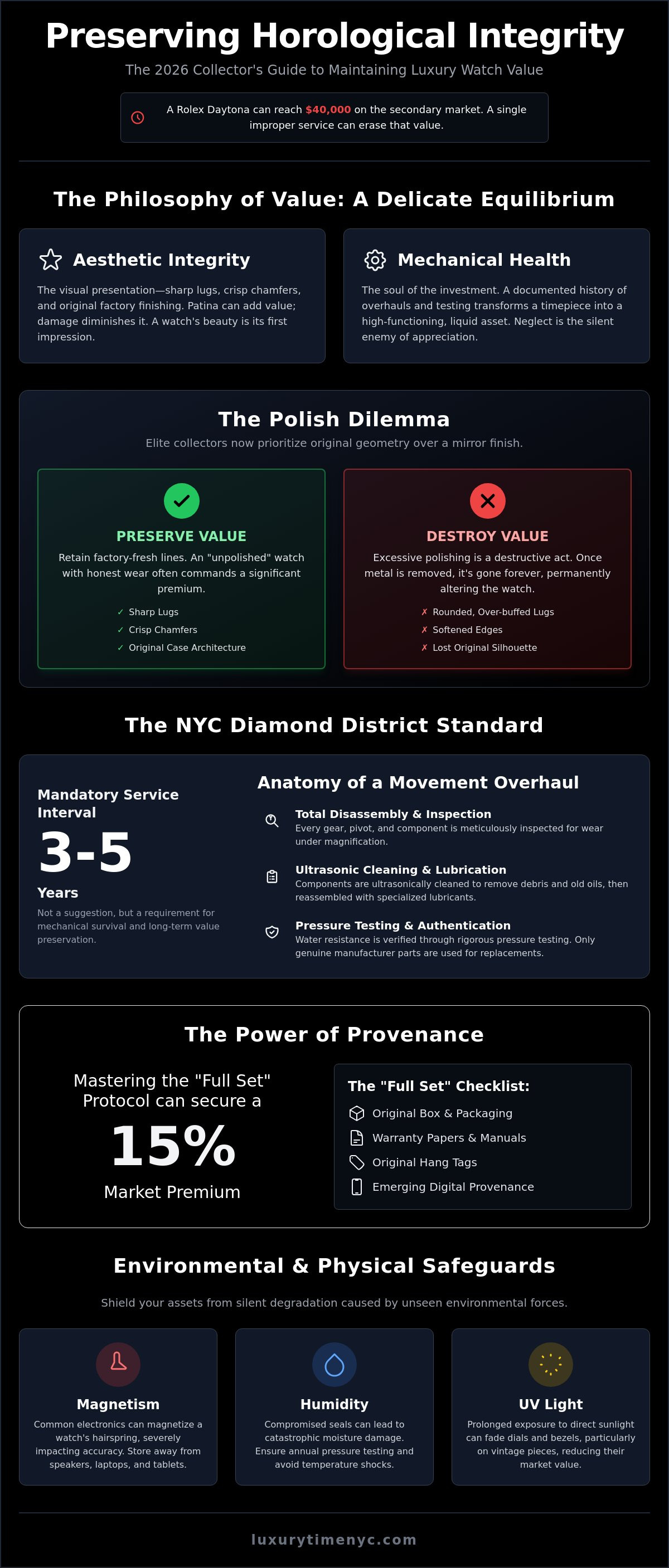
The secondary market has shifted. Today’s elite collectors prioritize original geometry over a mirror finish. Excessive Watch Polishing can be a destructive act. It rounds off the sharp lugs of a Patek Philippe and softens the crisp chamfers of an Audemars Piguet. Once that metal is removed, the original case architecture is lost forever. Collectors now pay a premium for "unpolished" examples that retain their factory-fresh lines. Professional polishing should only be considered when damage is significant, and even then, it must be performed by masters who respect the original silhouette. In many instances, an honest scratch is a badge of authenticity that preserves value better than a rounded, over-buffed lug.
Mechanical Health as a Value Foundation
The movement is the soul of the investment. While the dial captures the eye, the caliber determines the liquidity. Neglecting a service interval allows lubricants to dry. These oils eventually turn into abrasive pastes that wear down delicate escapement components and pivots. For those seeking a deeper technical grounding, understanding mechanical watch movements reveals why internal friction is the silent enemy of appreciation. A documented history of Movement Overhaul and Pressure Testing transforms a timepiece from a mere accessory into a verified, high-functioning asset. Mechanical integrity is the primary driver of horological liquidity.
Professional Servicing: The NYC Diamond District Standard
Manhattan’s Diamond District is the global epicenter for high-stakes horology. It is a square mile where the world’s most complex calibers are dismantled and revived by master hands. Understanding how to maintain luxury watch value begins with a commitment to this metropolitan standard of excellence. For prestigious houses like Rolex and Patek Philippe, a three-to-five-year service interval is not a suggestion; it is a requirement for mechanical survival. Entrusting a high-complication piece to a generalist repair shop is a risk that few serious collectors are willing to take. The intricate architecture of a perpetual calendar or a split-seconds chronograph requires specialized tooling and deep, brand-specific knowledge.
Waterproof integrity is another critical pillar of preservation. For iconic models like the Rolex Submariner, annual Pressure Testing is essential. Seals and gaskets degrade over time, and a single microscopic breach can lead to catastrophic moisture damage. A watch with a compromised movement due to water ingress loses significant market appeal and technical viability. Maintaining the factory-spec depth rating is a non-negotiable aspect of long-term asset protection.
The Anatomy of a Movement Overhaul
A true Movement Overhaul is a clinical process. It involves the total disassembly of the caliber, where every gear and pivot is inspected for wear. Components then undergo ultrasonic cleaning to remove microscopic debris and aged oils. Re-assembly requires the precise application of specialized lubricants, ensuring that the escapement functions with factory-level friction. Authenticity is paramount. Only genuine manufacturer parts should be used to replace worn components. For a deeper look into this meticulous process, consult the connoisseur’s guide to luxury watch repair in NYC.
Choosing a Master Watchmaker in Manhattan
The selection of a watchmaker should be as deliberate as the acquisition of the timepiece itself. You must seek professionals with documented experience handling specific modern calibers, such as the Rolex 3235 or the Patek Philippe 240. Transparency is the ultimate currency. A master watchmaker provides detailed service receipts and timing results, which serve as essential provenance for future resale. At Luxury Time NYC, our repair philosophy is rooted in "preservation-first" horology. We focus on maintaining the original soul of the machine while ensuring peak performance. If your collection is approaching its next milestone, we invite you to explore our Movement Overhaul services for a private consultation on how to maintain luxury watch value through expert care.
The Provenance Protocol: Managing Documentation and Digital Identity
In the elite secondary market, a watch is only as valuable as the evidence supporting it. A "Full Set"—comprising the original box, warranty papers, and hangtags—typically commands a 10-15% premium over a "naked" timepiece. This documentation is the final word on authenticity. As the global luxury market reaches £38 billion in 2026, the strategy for how to maintain luxury watch value has evolved into a digital discipline. Blockchain-powered digital passports now offer an immutable ledger of a timepiece's history. These digital identities complement physical archives, creating a dual layer of security that appeals to the modern, data-driven investor. Professional Watch Authentication acts as the anchor for this entire system, ensuring the chain of custody remains unbroken.
Original vs. Aftermarket: The Cost of Modification
Aftermarket modifications are the antithesis of value preservation. Adding non-factory components, such as diamond-set bezels or custom dials, effectively compromises the watch’s status as a pure asset. In the world of Rolex and Patek Philippe, originality is the ultimate currency. Collectors seek "period-correct" parts that match the exact manufacturing era of the watch. A single non-genuine component in the caliber can disqualify a piece from high-end auctions.
| Component Type | Impact on Investment Value |
|---|---|
| Original Factory Parts | Maximum appreciation and liquidity. |
| Period-Correct Restoration | Maintains historical integrity and collector appeal. |
| Aftermarket Modifications | Significant reduction in resale ceiling; often deemed "mutilated." |
| Non-Genuine Caliber Parts | Potential total loss of marketability and authentication failure. |
Building a Service Paper Trail
Every service receipt functions as a new birth certificate for your watch’s current health. These documents prove that the movement has been maintained to the manufacturer’s rigorous specifications. We recommend maintaining a physical binder alongside a secure digital storage solution for high-resolution scans of every invoice. This meticulous record-keeping is a fundamental part of how to maintain luxury watch value over decades. When the time comes to sell luxury watches, a complete service history allows you to command the highest possible market price. It transforms a simple transaction into the transfer of a verified, high-functioning legacy.
Environmental and Physical Safeguards for High-Value Assets
A climate-controlled safe is the first line of defense for a serious collection. Beyond theft, a timepiece faces three silent killers: magnetism, humidity, and ultraviolet light. Modern life is saturated with magnetic fields from speakers and tablet covers. These fields can cause the delicate hairspring to stick, leading to a sudden, frustrating loss of accuracy. Understanding how to maintain luxury watch value involves recognizing these invisible threats before they manifest as mechanical failure. Humidity is equally treacherous. It accelerates the degradation of gasket seals and can lead to microscopic oxidation on the movement’s bridges. For vintage pieces, prolonged UV exposure can cause irreversible dial fading, which, while sometimes prized as "tropical" patina, is often a gamble that reduces marketability.
Physical habits are just as critical. Always ensure the crown is fully screwed down before any proximity to moisture. This simple action preserves the vacuum seal required for Pressure Testing integrity. Financial protection is the final layer of this safeguard strategy. Specialist watch insurance, typically costing 1% to 2% of the insured value annually, is essential. Because the market for Rolex and Patek Philippe is so dynamic, appraisals should be updated every two to three years to reflect current secondary market peaks.
The Watch Winder Debate for 2026
The necessity of a watch winder depends entirely on the caliber’s complexity. For a perpetual calendar, a winder is a logical tool. It prevents the intricate calendar work from stopping, which saves the owner from the arduous task of resetting the moon phase and leap year indicators. However, for a standard automatic movement, constant rotation can cause unnecessary wear on the rotor bearing and mainspring. If you utilize a winder, you must set the correct Turns Per Day (TPD) for your specific caliber. A modern Rolex typically requires 650 TPD, bi-directional. Manual-wind timepieces should never be placed on a winder; they require a deliberate, tactile winding routine that respects the resistance of the mainspring.
Daily Wear Precautions for Collectors
Preserving a watch does not mean consigning it to a vault. It means wearing it with a specific awareness. "Desk diving" is the most common cause of unsightly clasp scratches on high-polish Oyster or Nautilus bracelets. Mindful wrist placement can prevent these surface abrasions that often tempt owners into unnecessary Watch Polishing. Chemical exposure is another overlooked risk. Perfumes, colognes, and soaps contain oils that can eventually dry out and crack the rubber gaskets responsible for water resistance. A luxury watch is engineered for precision, but its value is preserved through mindful environment control. To ensure your collection remains in peak investment condition, consider a professional Watch Authentication and health check to identify environmental wear before it becomes a liability.
Strategic Portfolio Management with Luxury Time NYC
Strategic management is the final pillar of a successful collection. It requires a shift in perspective from seeing a timepiece as a standalone object to viewing it as a component of a high-performing portfolio. Luxury Time NYC serves as a discreet advisor in this process, offering the professional distance and market insight necessary for high-value decisions. We assist our clients in understanding how to maintain luxury watch value while identifying the precise moment to pivot toward a more significant acquisition. Our presence in the NYC Diamond District provides a vantage point that generalist dealers cannot replicate; we witness the shifts in global demand before they manifest as price fluctuations on the secondary market.
Trading-in is a sophisticated tool for the modern collector. It allows you to leverage the appreciation of a steel Rolex or a Cartier Tank to acquire a high-complication Patek Philippe or a rare Audemars Piguet. This transition improves the overall quality and rarity of your holdings. A smaller, more curated collection of "heavy hitters" is often easier to manage and appreciates more reliably than a fragmented assembly of entry-level pieces. Consolidating your collection into blue-chip assets is a proven strategy for long-term wealth preservation.
Before concluding, we offer this definitive checklist for the 2026 collector. Adhering to these points is the most effective way to ensure your investment remains liquid and prestigious:
- Movement Overhaul: Every three to five years by a master watchmaker to prevent internal wear.
- Pressure Testing: Annual verification of water resistance, especially for sports models like the Submariner.
- Meticulous Provenance: Secure storage of the "Full Set," including original boxes, papers, and digital blockchain certificates.
- Environmental Control: Shielding assets from the silent degradation of magnetism, humidity, and UV light.
- Authentication: Regular verification of every component's originality to protect the chain of custody.
The Luxury Time NYC Advantage
Our commitment to absolute authenticity is the foundation of our reputation. We don't just facilitate transactions; we curate mechanical legacies. Our inventory features the most sought-after models from Rolex, Patek Philippe, and Audemars Piguet, each vetted for horological excellence. For those looking to expand their holdings or enter the market for the first time, our guide on buying a Rolex in NYC provides essential insights into current market dynamics and availability.
Securing Your Horological Legacy
Professional maintenance today ensures generational wealth tomorrow. A timepiece is a portable, global asset that transcends borders and traditional currency fluctuations. Its value is only as stable as the care it receives and the documentation that supports it. We invite you to visit our Manhattan showroom for a private consultation regarding your collection's health and future trajectory. Schedule your appointment at Luxury Time NYC today.
The Future of Your Horological Legacy
A fine timepiece is a vessel of history and engineering that demands more than passive admiration. It requires a strategic commitment to mechanical precision and meticulous documentation. By embracing the NYC standard of professional servicing and maintaining a rigorous provenance protocol, you ensure your collection remains a liquid and appreciating asset. Mastering how to maintain luxury watch value is the hallmark of the modern connoisseur who views time as both a luxury and an investment.
Our institution, situated in the center of NYC’s Diamond District, offers an unparalleled sanctuary for your high-value assets. As specialists in Patek Philippe, Rolex, and Audemars Piguet, our on-site Certified Master Watchmakers deliver the technical excellence your collection requires. We invite you to experience a level of care that matches the prestige of your timepieces.
Preserve your investment—Consult with our Master Watchmakers at Luxury Time NYC
The stewardship of your collection is a journey of refinement. Trust the experts who understand the weight of your legacy.
The lifestyle of a serious collector is often defined by an appreciation for artisanal excellence across all categories. Just as you curate your watch box with precision, you can explore Acid Kuba Kuba to discover how Gotham Cigars maintains the highest standards for tobacco enthusiasts.
Frequently Asked Questions
How often should I service my luxury watch to maintain its value?
Professional servicing should occur every three to five years to ensure mechanical longevity. This interval allows a master watchmaker to replace aging lubricants before they dry and cause friction-related wear on delicate pivots. Adhering to this schedule is a fundamental aspect of how to maintain luxury watch value, as it preserves the movement in factory-spec condition for future collectors.
Does polishing a Rolex decrease its resale value?
It frequently does. Modern collectors prioritize "unpolished" examples that retain their original factory geometry and sharp lug edges. Every polishing session removes a microscopic layer of metal, which can eventually round off the crisp chamfers that define the watch's silhouette. Unless the case has sustained deep, disfiguring trauma, the market generally prefers the honesty of original factory finishing.
Is it worth keeping the original box and papers for a luxury watch?
Original documentation is essential for maximizing your investment. A "Full Set" including the box, warranty papers, and hangtags typically commands a 10% to 15% premium on the secondary market. These items provide an unbroken chain of provenance and act as the primary evidence of authenticity, which significantly increases the liquidity of the asset when you decide to sell.
Can I wear my luxury watch every day without losing value?
Daily wear is perfectly acceptable if you practice mindful ownership. While these timepieces are engineered for durability, avoiding "desk diving" scratches on the clasp and keeping the watch away from harsh chemicals will preserve its aesthetic integrity. Consistent, careful use combined with regular pressure testing ensures that the watch remains a high-functioning asset rather than a neglected relic.
How do I know if my watch has been magnetized?
A sudden and significant gain in time is the most common symptom of magnetism. If your watch begins running several minutes fast per day, the hairspring coils may be sticking together due to a magnetic field. You can test this by placing a traditional compass near the timepiece; if the needle deflects, the movement requires professional demagnetization to restore its chronometric precision.
What is the most important document for a luxury watch investment?
The original warranty paper or card is the most critical document in your archive. It serves as the watch’s birth certificate, featuring the unique serial number and the authorized dealer's stamp. While service invoices are vital for proving mechanical health, the original warranty remains the definitive anchor for authenticity and is the first thing a serious buyer will request.
Should I use a watch winder for my automatic timepiece?
Winders are highly recommended for perpetual calendars but are often unnecessary for simpler automatic movements. For a complex calendar, a winder prevents the arduous task of resetting moon phases and leap year indicators. However, for a standard three-hand watch, allowing the movement to rest when not in use can prevent unnecessary wear on the rotor bearings and mainspring.
How much does a professional movement overhaul cost in NYC?
The investment for an overhaul depends entirely on the caliber’s complexity and the brand’s specific requirements. A high-complication chronograph requires more intensive labor and specialized tooling than a standard mechanical movement. In the NYC Diamond District, professional rates reflect the use of genuine manufacturer parts and the expertise of certified master watchmakers. A private assessment is the only way to determine a precise cost for your specific timepiece.


