


The most intimate component of a luxury timepiece is not the mechanical movement, but the supple leather strap that anchors it to your wrist. It's an organic element that requires a level of attention equal to the fine engineering within the case. Many collectors mistakenly treat leather as a static material, yet it responds to every environment, every drop of moisture, and every shift in temperature.
You've likely felt a pang of concern when noticing the initial signs of a dry crack on a rare alligator hide or the subtle emergence of an unpleasant odor after a summer afternoon. Conflicting advice on heavy oils and household cleaners only adds to the anxiety of potentially damaging a high-value asset. We recognize that for the serious collector, a compromised strap diminishes the entire aesthetic of a Rolex or Patek Philippe.
This guide provides the definitive professional standard on how to care for a leather watch strap with absolute precision. You'll master the art of deep preservation, ensuring your strap remains as fresh and resilient as the day it was first fitted. From neutralizing sweat to selecting pH-correct conditioners, we'll walk through the essential rituals that protect the integrity of the leather and the prestige of your timepiece.
Key Takeaways
- Understand why preserving the pH balance of porous hides like French Calfskin is essential for maintaining long-term suppleness and color integrity.
- Learn the professional cleaning protocol, starting with the dry brush phase and the critical requirement of removing the strap to safeguard the watch movement.
- Master the 24-hour rest rule and rotation strategies to discover how to care for a leather watch strap by allowing natural moisture evaporation.
- Discover the specialized requirements of exotic skins, including the necessity of wax-free, protein-based conditioners for Alligator and Crocodile hides.
- Recognize the definitive signs of structural failure at spring bars and buckle holes to determine when a strap has reached its professional hygiene threshold.
The Anatomy of Luxury Leather: Why Fine Straps Require Specialized Care
The leather strap is the most intimate connection between a connoisseur and their timepiece. Unlike the impervious sapphire crystal or the brushed 904L steel of a Rolex, the strap is organic. It lives. It breathes. It reacts. Understanding the biological reality of high-end hides is the first essential step in learning how to care for a leather watch strap.
Top-tier materials like French Calfskin and Alligator are prized for their porous structure. These pores allow the leather to remain supple. Yet, they also act as conduits for environmental contaminants. When skin oils and perspiration penetrate these fibers, they introduce salts and acids that slowly degrade the protein bonds. Mastering how to care for a leather watch strap requires an understanding of this delicate chemical equilibrium. Maintaining a stable pH balance is the absolute priority. Leather is naturally slightly acidic; when exposed to alkaline cleaning agents or excessive sweat, the fibers become brittle. This leads to irreversible cracking. Such damage diminishes the prestige of even the finest Audemars Piguet.
Adopting a preservation mindset means viewing the strap as a critical component of a high-value investment. This approach mirrors professional leather conservation techniques used to protect historical artifacts. It's about proactive defense. It's about ritual. It's about treating a living material with the same respect as a mechanical movement.
Differentiating Hide Types: Calfskin vs. Exotic Skins
Calfskin is the industry standard for durability. It develops a deep, characteristic patina over time. It's resilient. It's classic. Exotic hides like Alligator and Crocodile present a complex architecture of rigid scales and flexible membranes. These membranes are particularly vulnerable to drying. Ostrich hides, with their distinctive quills, require delicate handling to avoid flattening the texture. Suede and Nubuck are different. Their napped surfaces are highly absorbent. Any liquid contact can cause permanent staining. These materials require specialized brushes and zero moisture.
The Role of the Strap in Watch Valuation
A pristine Cartier or Patek Philippe demands a strap of equal caliber. A frayed, discolored, or malodorous strap immediately detracts from the watch's visual prestige. It signals neglect. Originality is paramount. Preserving the original buckles and deployment clasps ensures the timepiece remains a "full set" in the eyes of collectors. This stewardship is as vital as a movement overhaul or regular pressure testing. Horological leather is a specialized grade of hide selected for its exceptional suppleness and high tensile strength.
The Cleaning Ritual: A Step-by-Step Restoration Process
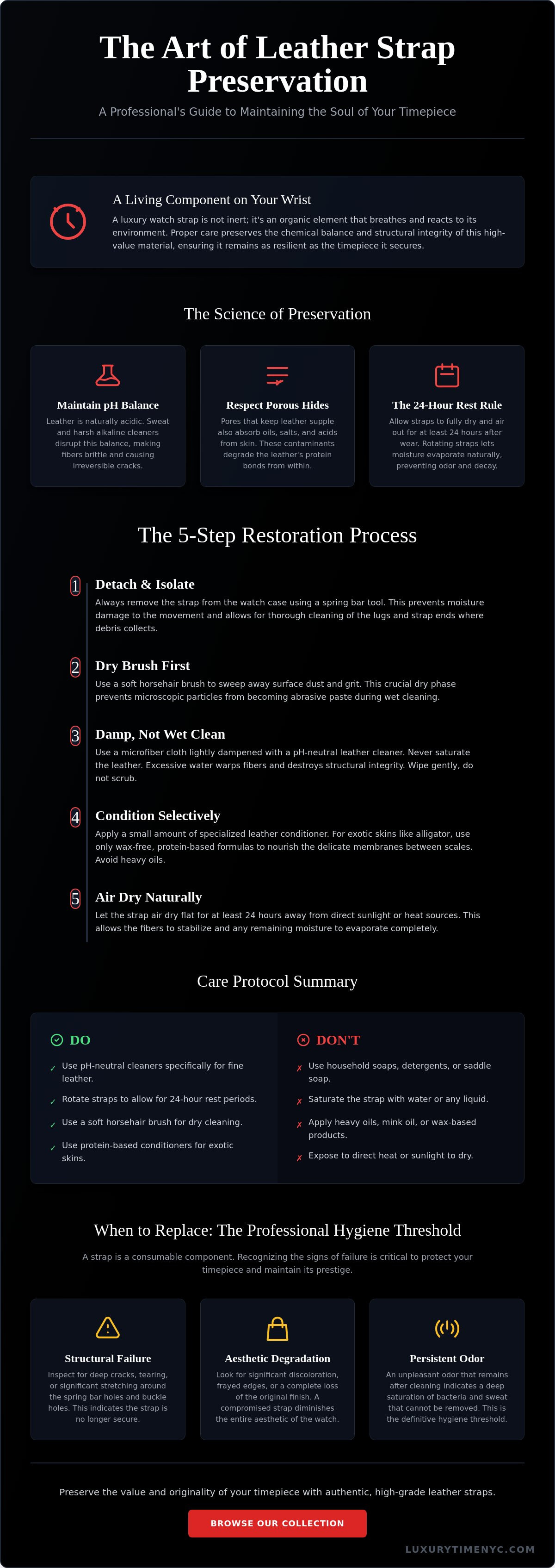
Elegance requires a disciplined hand. The process of how to care for a leather watch strap begins long before a cleaning agent is selected. First, clear a dedicated workspace. Detach the strap from the watch head using a professional spring bar tool. This simple act of separation is vital. It eliminates the risk of moisture entering the case or cleaning residues affecting a delicate movement overhaul. It allows for a comprehensive cleaning of the lugs and the strap ends, areas where debris often accumulates unnoticed.
The initial phase is strictly dry. Surface particulates are silent assassins. Use a fine horsehair brush to sweep away dust and microscopic grit. These particulates act as abrasives if pressed into the leather during a wet cleaning phase. Once surface debris is removed, the 'Damp, Not Wet' rule applies. Moisture is a tool, not a bath. Excessive water saturates the core fibers. This leads to warping and the loss of structural integrity. Adhering to preventive conservation guidelines regarding moisture control ensures that the cleaning process doesn't inadvertently accelerate the aging of the hide.
The Correct Tools for the Task
Standard household soaps are unsuitable. Even saddle soap, often recommended for equestrian gear, is far too alkaline for the refined hides used by Cartier or Patek Philippe. Instead, select a pH-neutral cleaner specifically formulated for horological leather. A horsehair brush is superior for textured skins like Alligator, while a lint-free microfiber cloth is ideal for smooth French Calfskin. While the strap is detached, it's an opportune moment to consider if the watch head itself requires professional watch polishing to match the restored brilliance of the leather.
Executing the Deep Clean
Focus your attention on the lining, often called the 'sweat side.' This area absorbs the majority of biological oils and salts. Apply your cleaner to the cloth, never directly to the leather. Use light, circular motions. Be particularly cautious with contrast stitching. If the thread becomes overly saturated, it may absorb dyes from the surrounding hide, ruining the visual contrast. Finally, allow the strap to air-dry naturally. Never use a radiator or hairdryer. Heat is the enemy. It causes the leather to shrink and crack. Odors are neutralized not by fragrance, but by the physical removal of the bacteria and salts trapped within the pores. This ritual ensures your strap remains as refined as the timepiece it supports.
Environmental Protection and the 24-Hour Rest Rule
Time is the ultimate luxury. For the leather on your wrist, time is also a physical necessity. The 24-hour rest rule is the cornerstone of professional maintenance. When you wear a fine strap, it absorbs microscopic amounts of perspiration and ambient humidity. If you don't allow this moisture to evaporate fully, the internal fibers remain saturated. This state of constant dampness invites bacterial growth and structural decay. A true connoisseur understands that knowing how to care for a leather watch strap involves a disciplined rotation strategy. By alternating between a Rolex and a Cartier, you give each strap the 24 hours of stillness required to 'reset' its structural integrity.
Environmental factors are equally decisive. Ultraviolet (UV) radiation is a silent catalyst for deterioration. Direct sunlight bleaches deep dyes and evaporates the essential oils that keep the hide supple. While the dial of your Patek Philippe is protected by sapphire, the strap remains vulnerable. For more general advice on maintaining various leather goods, resources like How to Clean Leather provide a baseline. However, horological leather requires a more disciplined environmental shield to prevent the premature aging of the grain.
The Manhattan Climate Factor
New York City presents a unique set of challenges. The high humidity of a Manhattan summer can over-saturate leather in hours. Conversely, the dry, forced-air heat of a Midtown office in winter acts as a desiccant. It pulls moisture out too quickly, leading to brittle fibers. Storage is paramount. Avoid airtight plastic containers. Use cedar-lined boxes or ventilated watch rolls. These materials allow the leather to breathe while maintaining a stable micro-climate for your collection.
Water Resistance vs. Water Proofing
The term 'water-resistant' is often a marketing misnomer. No organic hide is truly waterproof. If you're caught in a sudden New York rainstorm, immediate first aid is required. Pat the strap dry with a clean microfiber cloth. don't rub the surface. Rubbing can push moisture deeper into the pores. Allow it to dry at room temperature. Never place it near a heat source like a radiator. For added protection, consider applying a high-end, fluorocarbon-free water repellent. This creates a microscopic barrier that causes water to bead on the surface without compromising the leather's ability to breathe. This proactive defense is essential for anyone mastering how to care for a leather watch strap.
Specialized Conditioning for Exotic and Rare Skins
Exotic skins represent the zenith of horological luxury. Alligator, Crocodile, and Ostrich aren't merely materials. They are architectural statements. Understanding how to care for a leather watch strap of this caliber requires a departure from standard calfskin protocols. These hides possess a unique biological complexity that reacts poorly to generic treatments. A connoisseur treats each species with specific reverence, recognizing that the chemistry of a reptilian scale differs fundamentally from the grain of a mammal's skin.
Conditioning Exotic Hides
Alligator and Crocodile straps present a specific challenge: the 'scales vs. membranes' dichotomy. The scales are dense and relatively impervious. The membranes between them are the points of flex and vulnerability. Standard conditioners often contain heavy waxes that clog these membranes. Over time, these waxes dry into a white, brittle residue that attracts grit and causes the leather to crack. You must use a wax-free, protein-based conditioner. These specialized creams penetrate the membranes without suffocating the scales. Apply the cream sparingly with a lint-free cloth. Use a soft horsehair brush to buff the surface, ensuring no product remains in the crevices. This technique achieves a deep, natural luster known as the 'Connoisseur’s Glow' without the artificial, plastic-like shine of cheap silicone sprays.
Other rare materials require even more restraint. Shell Cordovan, a dense muscle membrane rather than a hide, is prized for its high oil content and glassy finish. It rarely needs conditioning; a simple rubbing with a smooth deer bone or a soft cloth often restores its brilliance. Suede and Nubuck are different. They should never touch liquid conditioners. Instead, employ the 'Nap Brush' technique. Use a specialized brass or rubber brush to gently lift the fibers and remove dust. For those investing in high-value assets like Cartier Watches, maintaining these specialized straps is essential for preserving the piece's heritage and market value.
When Less is More: Avoiding Over-Conditioning
The most common error in luxury strap maintenance is zeal. Over-conditioning leads to 'suffocated' leather. When the internal fibers are over-saturated with oils, they lose their tensile strength. The strap becomes excessively soft, loses its shape, and may even begin to stretch at the buckle holes. It's a sign of structural rot. For a daily-wear strap, a light conditioning every three to four months is sufficient. If the strap is part of a rotated collection, once or twice a year is the professional standard. Over-conditioning is the leading cause of strap failure in luxury collections. A disciplined approach ensures the leather remains resilient, supporting the watch head with the security and elegance it deserves.
Professional Maintenance and Knowing When to Replace
Even with a disciplined mastery of how to care for a leather watch strap, every organic hide possesses a finite lifecycle. It's a matter of structural integrity. Connoisseurs must remain vigilant for deepening fissures at the spring bar loops. These are critical failure points. If the leather here thins or cracks, you risk the watch head detaching entirely. Similarly, elongated or frayed buckle holes indicate the fibers have lost their internal tensile strength. At this stage, the ritual of preservation ends. Replacement becomes a necessity to ensure the security of your high-value investment.
The hygiene threshold is the second decisive factor in strap stewardship. Leather is porous. Over years of consistent wear, it can reach a point of saturation where professional cleaning no longer suffices. If a persistent, unpleasant odor remains after a disciplined deep clean, the biological contaminants have moved beyond the surface and into the core lining. This is the moment to retire the component. Maintaining the professional standard of care means recognizing when a strap no longer reflects the excellence of the timepiece it supports. A degraded strap on a Patek Philippe is an aesthetic contradiction that should be avoided.
The Luxury Time NYC Standard of Care
We provide a bespoke approach to strap maintenance for elite collectors. Our specialists offer professional cleaning and conditioning services that go beyond home rituals. Proper fitting is essential. A strap that is even a millimeter too narrow allows the spring bar to shift, leading to premature wear on the watch lugs. Seeking professional watch repair nyc ensures that your spring bars are tested and your strap is seated with factory-level precision. We also assist in sourcing rare, authentic leather replacements for vintage Rolex and Audemars Piguet models, ensuring every component remains period-correct.
Investing in a New Aesthetic
A new strap is more than a replacement; it's a transformation. It revitalizes the look of a classic Rolex, shifting its character from a formal instrument to a relaxed companion. For those considering a transition in their collection, a pristine, well-maintained strap significantly impacts the piece's marketability. When your timepiece is kept in this professional condition, we are established as the best place to sell watches in the Manhattan market. Visit our Diamond District showroom for a private consultation. We'll evaluate your timepiece's condition and help you curate an aesthetic that honors its heritage while ensuring you understand exactly how to care for a leather watch strap in the years to come.
Preserving Your Horological Legacy
True mastery of a luxury collection extends beyond the mechanical movement to the very hide that secures it. You've now gained the specialized knowledge required to maintain this vital connection. By embracing the 24-hour rest rule and the disciplined cleaning rituals outlined here, you've mastered the professional standard of how to care for a leather watch strap. These small, deliberate acts of stewardship ensure your timepiece remains a testament to both fine engineering and personal refinement.
Occasionally, a high-value asset requires the intervention of a specialist. Our expert horologists, situated in the heart of the NYC Diamond District, are dedicated to the meticulous maintenance of Rolex, Patek Philippe, and Audemars Piguet timepieces. We provide a sanctuary for your collection, where authenticity is guaranteed for every replacement part and service. Schedule a professional maintenance appointment at Luxury Time NYC to experience our uncompromising standard of care. Your legacy deserves nothing less than absolute excellence.
Frequently Asked Questions
How often should I clean my leather watch strap?
Clean your strap every two to three weeks for light maintenance and every three to four months for a deeper restoration. Frequent wear in humid climates requires more vigilance. A light wipe with a dry microfiber cloth after each wear prevents the accumulation of salts. This disciplined schedule is the foundation of how to care for a leather watch strap effectively.
Can I use coconut oil or olive oil to condition my strap?
Avoid using food-grade oils such as coconut or olive oil on your luxury strap. These organic substances eventually go rancid within the leather's pores. They cause permanent discoloration and attract bacteria. Only utilize pH-neutral, protein-based conditioners specifically formulated for fine horological hides. This ensures the fibers remain supple without compromising the material's chemical integrity or visual elegance.
How do I get the 'sweat smell' out of my luxury watch strap?
Eliminate odors by physically removing the bacteria and salts trapped in the leather lining. Use a specialized, pH-neutral leather soap and a damp cloth to neutralize the "sweat side." Once cleaned, the 24-hour rest rule is essential to allow complete moisture evaporation. Never attempt to mask odors with colognes or sprays. These chemicals often contain alcohols that cause the leather to become brittle.
Is it safe to wear my leather strap in the shower if the watch is waterproof?
Never wear a leather strap in the shower, regardless of the watch's water resistance rating. The combination of hot water and alkaline soaps is catastrophic for organic hides. Heat causes the leather to shrink and warp. Soap residues strip away the natural oils that prevent cracking. If your timepiece is rated for water, reserve the shower or pool for rubber or metal bracelets only.
Why is my leather strap cracking near the buckle?
Cracking near the buckle is typically the result of mechanical stress combined with environmental dryness. The constant bending of the strap at the same point causes the fibers to fatigue. When the leather lacks sufficient internal moisture, it loses its elasticity and snaps. This is a definitive sign of structural failure. It suggests the strap has reached the end of its safe operational life.
Can a professional watchmaker restore a discolored exotic skin strap?
Professional restoration for discolored exotic skins is often limited once the dye has been compromised. While some specialist conservators can perform light re-pigmentation, the results rarely match the factory finish of a Patek Philippe or Cartier strap. Prevention through UV protection is the only reliable method. If the discoloration is severe, sourcing an authentic replacement is the standard for maintaining the watch's value.
What is the best way to store leather-strapped watches when not in use?
Store your leather-strapped watches in a ventilated, dark, and temperature-controlled environment. A cedar-lined box or a high-quality watch roll provides the necessary airflow while protecting against UV damage. Avoid airtight plastic containers. These trap humidity and can lead to mold growth or the "suffocation" of the leather. Proper storage is a critical aspect of how to care for a leather watch strap.
Should I use a deployment clasp to save my leather strap from wear?
A deployment clasp is an excellent investment for extending the life of your strap. Unlike a traditional tang buckle, a deployment clasp reduces the need to bend and pull the leather during the fastening process. This minimizes the friction and mechanical strain placed on the buckle holes. It preserves the strap's shape and prevents the common creasing that eventually leads to structural failure at the midpoint.


