


A fine timepiece isn't a mere purchase; it's a strategic acquisition of heritage. While many luxury assets lose 20 percent of their value the moment they're worn, specific classic watches from the 2024 Phillips Geneva auction demonstrated that horological excellence remains a formidable hedge against market volatility. You've likely felt the frustration of comparing two seemingly identical steel chronographs only to find a price gap that defies logic. It's a common hurdle for the modern collector who values both aesthetics and equity.
This guide ensures you select an investment-grade masterpiece that balances mechanical caliber with enduring market demand. You'll learn to look past the dial to the complications beneath, ensuring your next acquisition holds its value for generations. We'll examine the "Holy Trinity" of Swiss watchmaking, decode technical jargon, and verify the provenance required for a true heirloom. Your journey into the elite world of high horology starts here.
Key Takeaways
- Distinguish between fleeting trends and true horological icons by mastering the hallmark characteristics of investment-grade pieces.
- Evaluate the technical caliber and material provenance required to ensure your timepiece retains its status as a high-value asset.
- Understand why the "Holy Trinity"—Rolex, Patek Philippe, and Cartier—defines the market for classic watches among the global elite.
- Apply a sophisticated framework to balance emotional connection with the rigorous financial valuation necessary for building a curated collection.
- Navigate the exclusive 47th Street New York watches landscape with the authority and security of a seasoned connoisseur.
Defining the Classic Watch: Beyond Mere Aesthetics
In 2026, the global market for horology has entered a period of profound reflection. Collectors no longer chase the fleeting novelty of silicon chips or the planned obsolescence of wearable tech. Instead, the focus has returned to classic watches. These are instruments of permanence. They represent a bridge between the industrial past and an aspirational future. The History of watches illustrates a fascinating evolution from essential maritime tools to symbols of absolute status. What began as a necessity for navigation in the 18th century has transformed into a marker of refined taste and investment prowess.
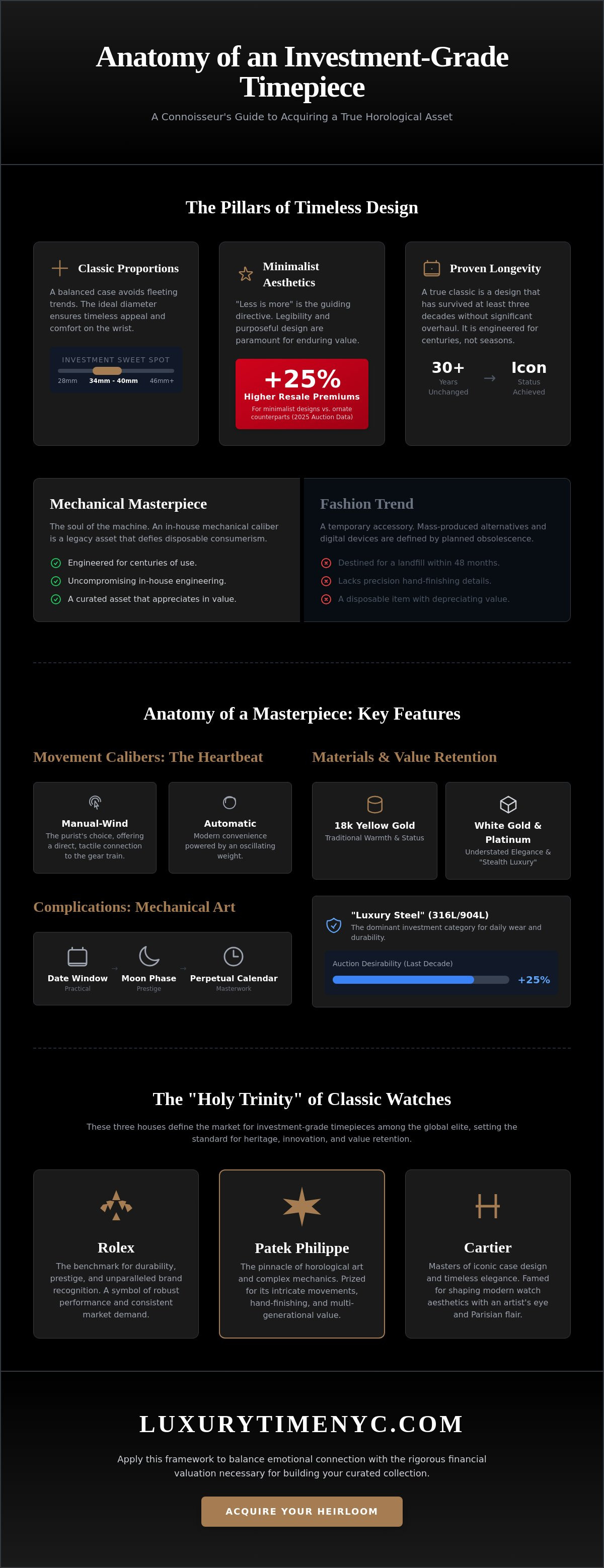
A true classic survives the erosion of time. While a modern smartwatch is destined for a landfill within 48 months, a mechanical masterpiece is engineered for centuries. This distinction is the bedrock of current collector demand. In New York City, the epicenter of global commerce, the preference for mechanical integrity over digital convenience is clear. It's about the soul of the machine. It's about provenance. A timepiece from a premier house isn't just an accessory; it's a curated asset that defies the cycle of disposable consumerism.
The Pillars of Timeless Design
Exclusivity begins with restraint. For a timepiece to be considered a classic, its proportions must adhere to a specific architectural logic. Case diameters typically reside within the 34mm to 40mm range. This ensures the watch remains balanced on the wrist, avoiding the garish trends of oversized fashion pieces. Legibility is the primary directive. A "less is more" philosophy dominates the dial, where every marker and hand serves a purpose. Data from 2025 auction cycles shows that minimalist aesthetics consistently command 25% higher resale premiums than their more ornate counterparts. Simplicity is the ultimate sophistication.
Mechanical Integrity vs. Fashion Trends
The beating heart of any serious timepiece is its in-house mechanical caliber. This internal architecture distinguishes a legacy asset from a mere accessory. A horological classic is a design that has survived at least three decades without significant overhaul. This longevity isn't accidental; it's the result of uncompromising engineering. Consider the hand-finished details of a Patek Philippe movement. Every bridge is chamfered; every screw is polished to a mirror finish. These details are absent in mass-produced alternatives. In 2026, the discerning collector understands that fashion is temporary, but a well-maintained movement is eternal. Unrivaled precision. Absolute authority.
The Anatomy of a Masterpiece: Key Features to Evaluate
A masterwork on the wrist is the result of deliberate engineering and artistic restraint. Serious collectors scrutinize every millimeter before committing to a high-ticket acquisition. It's about more than aesthetics. It's about the soul of the machine. Evaluating classic watches requires a technical eye and an appreciation for the heritage that defines a true investment piece.
Movement Calibers and Complications
The caliber is the heart of the timepiece. Manual-wind movements remain the purist's choice, offering a direct, tactile connection to the gear train through the daily ritual of winding. Automatic movements provide the modern convenience of an oscillating weight, a technology that gained significant market traction after 1931. Both require immense skill to assemble.
Complications add both utility and prestige. A simple date window is practical, but a moon phase or a perpetual calendar represents the pinnacle of mechanical art. These intricate systems are a testament to Swiss watchmaking history and require specialized care. Utilizing professional watch repair NYC services ensures these complex calibers remain functional for generations. Precision is a legacy that must be maintained.
Precious Metals and Case Geometry
Material choice dictates both the tactile experience and the long-term value retention of a timepiece. 18k yellow gold offers a traditional warmth that has signaled status for centuries. In contrast, white gold and 950 platinum provide an understated elegance for those who prefer stealth luxury. These metals are dense, providing a reassuring weight on the wrist that steel cannot replicate.
However, "luxury steel" has emerged as a dominant investment category. High-grade 316L or 904L stainless steel offers unrivaled durability for daily wear. Auction data from the last decade shows a 25% increase in the desirability of steel references from prestigious houses. The case shape further defines the watch's character:
- Round: The universal standard for formality and legibility.
- Rectangular: Often associated with the Art Deco movement of the 1920s; it suggests a refined, architectural taste.
- Tonneau: A barrel-shaped profile that provides a bold, vintage wrist presence.
The final element of the anatomy is the interface between the watch and the wearer. A hand-stitched alligator strap transforms classic watches into formal masterpieces. Conversely, an integrated metal bracelet offers a seamless, cosmopolitan look. Every detail, from the polish of the lugs to the weight of the clasp, contributes to the watch's provenance. Explore our exclusive collection of classic watches to find a piece that resonates with your personal style.
The Holy Trinity of Classics: Rolex, Patek Philippe, and Cartier
To understand the enduring appeal of classic watches, one must study the triumvirate that commands the global secondary market. Rolex, Patek Philippe, and Cartier represent more than horological excellence; they are the pillars of liquid luxury. At Luxury Time NYC, these manufacturers dominate our curated inventory because their value remains resilient against market fluctuations. They offer a rare combination of historical provenance and mechanical superiority. Choosing between them is a matter of aligning your personal narrative with the specific philosophy of a house.
- Patek Philippe appeals to the generational collector who values quiet mastery.
- Rolex serves the high-achiever who demands a timepiece as durable as it is prestigious.
- Cartier attracts the aestheticist who views horology through the lens of fine art and design.
The Patek Philippe Calatrava: The Gold Standard
The Calatrava has defined the round dress watch since its 1932 debut. It's the ultimate expression of the Patek Philippe philosophy: form follows function. Collectors frequently seek out specific references like the 3919 or the 5119, renowned for their "Clous de Paris" hobnail bezels. This intricate, guilloché pattern captures light with a sophistication that modern CNC machining rarely replicates. Patek Philippe remains the pinnacle of investment-grade classicism because of its limited production and unrivaled hand-finishing. Ownership isn't just a purchase. It's a stewardship of horological history.
Rolex Datejust: The Everyday Classic
The Datejust is the most versatile timepiece ever engineered. Released in 1945 to celebrate the brand's 40th anniversary, it successfully bridged the gap between rugged sports watches and formal attire. The signature Jubilee bracelet and fluted bezel serve as iconic design markers that are recognizable across a room. For many NYC collectors, the Datejust is the first "serious" acquisition. Its waterproof Oyster case and perpetual movement provide a level of reliability that few other classic watches can match. For a deeper analysis of specific configurations, consult our Rolex NYC guide.
Cartier Tank: The Art Deco Icon
Cartier proved that a masterpiece doesn't need to be round. Inspired by the aerial view of a Renault FT-17 tank, the Cartier Tank has remained a unisex style icon since 1917. While the Tank Louis Cartier maintains the traditional proportions and manual-wind heritage of the original, the Tank Française offers a more contemporary, architectural feel with its integrated metal bracelet. Cartier's "shape watches" provide a necessary alternative to the standard circular aesthetic. They prioritize geometry and Roman numeral layouts that have remained virtually unchanged for over a century. It's a choice for the connoisseur who values the intersection of Parisian elegance and Swiss precision.
The Collector’s Framework: How to Choose Your Heirloom
Selecting classic watches requires a dual-lens approach. It's a marriage of the heart and the ledger. In 2026, the market rewards those who prioritize long-term asset health over impulsive acquisition. A masterpiece on the wrist should represent both a personal milestone and a stable store of value. To maintain portfolio health, sophisticated collectors frequently buy and sell watches through established partners. This ensures liquidity and guarantees that every addition to the collection meets the highest standards of horological integrity.
Matching the Watch to Your Lifestyle
A watch must harmonize with your daily environment. Evaluate where the timepiece will spend its life. A delicate Patek Philippe Calatrava excels in a Midtown boardroom but lacks the robustness required for active weekend wear. Consider technical specifications as practical boundaries. A 30-meter water resistance rating protects against light rain; it's not a license for the pool. For those seeking versatility, a Rolex Datejust or an Omega Seamaster transitions seamlessly from day to night. These models offer the shock protection and water resistance necessary for modern life without sacrificing their status as classic watches. Practical elegance. Unrivaled utility.
Evaluating Provenance and Condition
Provenance is the documented history of a timepiece. It's the bridge between a simple object and a historical artifact. Original boxes, service receipts, and guarantee papers are not mere accessories. They are essential components that can increase a watch's market value by 20% to 35% compared to "naked" examples. Distinguish between honest wear and structural damage. Light surface scratches tell a story of use; rounded lugs or soft case edges suggest over-polishing that destroys the original silhouette. In 2026, the unpolished look is often more valuable than a refurbished one. Sharp chamfers and original factory finishes are the hallmarks of a true survivor.
- Verify service history: A movement that hasn't been regulated in over 5 years is a hidden cost.
- Analyze the dial: Look for "tropical" aging or consistent patina rather than localized spotting.
- Check the caliber: Ensure the movement matches the reference number and production year exactly.
Avoid the pitfall of the "bargain" vintage piece. If a price seems detached from the global market average, the watch likely hides significant mechanical or aesthetic flaws. Trust is the ultimate currency in horology. Every acquisition should be a step toward building a legacy that lasts for generations.
View the pinnacle of horological craftsmanship. Explore our curated selection of classic watches.
Acquiring Excellence: The Luxury Time NYC Experience
Luxury Time NYC stands as the definitive authority for collectors seeking classic watches in the heart of Manhattan. Our vault contains over 19,000 curated timepieces, representing one of the most significant horological archives in the world. We don't merely facilitate transactions; we curate legacies. Every acquisition is governed by a rigorous 10-point authentication process. This protocol examines everything from the movement's beat rate to the authenticity of the dial's luminous material. We ensure every component is period-correct and functioning at peak performance. Secure global shipping guarantees that your investment arrives in pristine condition, backed by full insurance and discrete packaging.
The Security of NYC Diamond District Sourcing
Our headquarters at 62 West 47th Street isn't just an office; it's a gateway to the world's most exclusive inventory. Being physically embedded in the 47th Street New York watches scene allows us to secure rare Patek Philippe and Rolex references the moment they become available. We often acquire pieces before they ever reach the public market. Our "by appointment" showroom model ensures that you receive the undivided attention of a senior consultant. This private environment is essential for discussing high-value acquisitions and examining the minute details of a potential purchase. We operate with a level of transparency that's rare in this industry, providing detailed condition reports and historical documentation for every piece in our collection.
Professional Maintenance for Your Investment
A mechanical investment requires ongoing stewardship. Our in-house horological services are designed to protect the longevity and value of your classic watches. We provide comprehensive caliber overhauls, using only genuine parts to maintain the integrity of the movement. Our technicians perform 10-bar pressure testing and accuracy calibrations to ensure your watch performs to factory specifications. We also offer specialized restoration services. Our polishing experts use microscopic techniques to remove surface wear without altering the sharp chamfers or case proportions that define a watch's identity. This balance of aesthetics and technical precision is what keeps a masterpiece valuable for generations.
The pursuit of a timeless timepiece ends with a partner you can trust. Our expertise is your greatest asset in building a collection that stands the test of time.
Defining Your Future Legacy
Selecting a timepiece is a commitment to heritage and mechanical mastery. A true investment focuses on the 3 core pillars of horology: provenance, caliber, and aesthetic restraint. Whether you're drawn to the 107 year history of the Cartier Tank or the technical dominance of a Patek Philippe, your choice defines your personal narrative for 2026 and beyond. It's about finding a masterpiece that resonates with your individual style. Unrivaled precision. Timeless design.
Luxury Time NYC bridges the gap between simple acquisition and true stewardship. Located in the historic NYC Diamond District, we provide a secure gateway to the world's most prestigious brands. Every one of our classic watches carries a Certified Authenticity Guarantee, ensuring total peace of mind for every collector. We don't just sell timepieces; we preserve them. Our expert in-house horological repair and maintenance team ensures your investment remains as precise as the day it was forged. You deserve a partner who understands that excellence is the only acceptable standard.
Browse our exclusive collection of 19,000+ Classic Watches
Your next heirloom is waiting to be discovered. We look forward to helping you secure a piece of history.
Frequently Asked Questions
What is the best classic watch for a first-time collector in 2026?
The Rolex Datejust 36 remains the premier choice for a first-time collector in 2026. Its 1945 heritage offers a perfect balance of durability and prestige. Alternatively, the Cartier Tank, designed in 1917, provides an entry into the world of rectangular horology. Both models represent safe entry points into the market. They'll ensure your initial investment's backed by decades of proven demand and aesthetic relevance.
Do classic watches hold their value better than modern sports watches?
Modern sports watches often see higher volatility, while classic watches provide a stable foundation for any portfolio. The 2023 Knight Frank Luxury Investment Index highlighted that fine timepieces saw a 147% increase in value over the last decade. While a steel sports model might command a higher temporary premium, a gold Calatrava retains its grace regardless of fleeting market trends. It's a matter of choosing enduring heritage over speculative hype.
How often should a mechanical classic watch be serviced?
You should have your mechanical timepiece serviced every 5 to 10 years to ensure peak performance. Since 2015, Rolex has officially recommended a 10 year service interval for its modern calibers. Omega suggests a period of 5 to 8 years for its Co-Axial movements. Regular maintenance prevents the drying of essential lubricants. This discipline preserves the movement's integrity and protects the long-term value of your exquisite investment.
Is it better to buy a classic watch with a leather strap or a metal bracelet?
Choose a leather strap for formal sophistication or a metal bracelet for daily resilience. A high-quality alligator strap typically requires replacement every 12 to 18 months due to moisture exposure. Conversely, a stainless steel or gold bracelet can last 25 years with professional cleaning. If you're seeking versatility, many collectors purchase both. This allows for a seamless transition from a boardroom setting to a weekend social gathering.
What is the difference between a vintage watch and a classic watch?
A vintage watch is defined by its age, whereas classic watches are defined by their enduring design language. Industry experts generally categorize any timepiece manufactured before 2004 as vintage. A classic model, like the Patek Philippe Calatrava, remains classic whether it was produced in 1932 or last month. It's about the silhouette and the soul of the piece. True elegance isn't tethered to a specific manufacturing date.
How can I verify the authenticity of a classic watch bought online?
Verify authenticity by requesting a full set of original documentation and inspecting the movement's serial numbers. Use a 10x magnification loupe to examine the dial printing and hand finishing. Authentic pieces from 2026 will feature precise, laser-etched markings that counterfeiters can't replicate. Always purchase from a dealer with a physical presence in a global trade hub. It's the only way to ensure accountability and provide peace of mind.
Why is the NYC Diamond District considered the best place to buy luxury timepieces?
The NYC Diamond District is the world's most concentrated market for rare horology and liquid assets. According to the Diamond District BID, this single block on 47th Street facilitates over $24 billion in annual commerce. It offers a level of inventory depth that's unrivaled globally. For a collector, this means access to pieces that never reach the public market. It's the epicenter of trust and expertise in the luxury watch industry.
Can I trade in my current watch for a classic model at Luxury Time NYC?
You can certainly trade in your current timepiece for a curated model through our exclusive exchange program. We provide a transparent appraisal process based on the current 2026 market data and the specific provenance of your watch. This allows you to leverage the value of your existing collection toward a new masterpiece. Our specialists ensure a discreet and efficient transaction. It's the most sophisticated way to evolve your personal horological legacy.


